
I’ve helped dozens of couples order wedding stationery, and this question comes up every single time. Let me walk you through the method I’ve used that actually holds up across all those scenarios.
Start with your attending guest count — the number of people who said “yes” on their RSVP, not the number of invitations you sent. If 150 guests are coming, that’s your baseline. From there, how many programs you need depends on three things: how you hand them out, who your guests are, and what the program looks like.
The Baseline Rule for How Many Wedding Programs to Order
Your baseline = number of attending guests. This is your starting point. Not invitations. Not “couples plus a few.” Actual people who RSVP’d yes.
Why not invitations? Because one invitation can cover two, three, or even five people. If you send 100 invitations and 80 couples RSVP, that invitation count would give you 20 extra you don’t need. On the other hand, if half your guests are singles, you’ll run short if you use the invitation count. The guest count is the only number that reflects real demand.
Now apply this adjustment grid based on how you plan to distribute the programs:
| Distribution Method | Baseline Multiplier | Notes |
|---|---|---|
| Usher hands one to every person | 1 per guest + 5% buffer | High compliance — kids will grab one too. Add 10% if many children. |
| Usher hands one to each couple | 1 per couple unit (plus single guests) | You’ll use fewer, but you must account for individual singles. Subtract 10–15% vs. guest count. |
| Self-serve at entry (basket or table) | 1 per 1.5 guests | People take fewer when unattended. Round up. |
| Placed on each seat | 1 per seat = same as guest count | Zero buffer needed — but account for no-shows. Order a handful extra for people who take two. |
Example: 150 guests, usher handing to every person → order 150 + 5% = 158, round to 160. Same 150 guests, self-serve → order 150 ÷ 1.5 = 100 programs, round to 110 for safety.
When to Order More (or Fewer) Than Your Guest Count
The baseline works, but these situations push the number up or down:
Souvenir Tendency
If your program is artistic — a folded fan, a seed packet, a hand-lettered booklet — guests will grab extras for keepsakes. I’ve seen as many as 15% of guests take two. Add 10% to your count if your program has souvenir value.
Program Format
A single one-page sheet? Almost everyone will take one. A multi-page booklet that’s thick? People are less likely to grab one unless they care about the content. You can reduce by 5–10% for bulky booklets in a self-serve scenario.
Conversely, a program that also serves as a fan, a fan program, will disappear fast. In summer outdoor ceremonies, order 1 per guest plus 10% — because guests will grab one to cool off even if they don’t read it.
Digital Supplement
Offer a QR code on a small sign at the entrance that links to a digital program. This allows you to cut physical orders by up to 20%. But only do this if you communicate it clearly — a small sign saying “scan here for the program” works best when paired with a few physical copies for older guests or anyone who prefers paper. In my experience, about 60% of guests still take a physical program even when a digital option is available, so don’t cut more than 20% of your baseline.
How Distribution Method Directly Affects Quantity
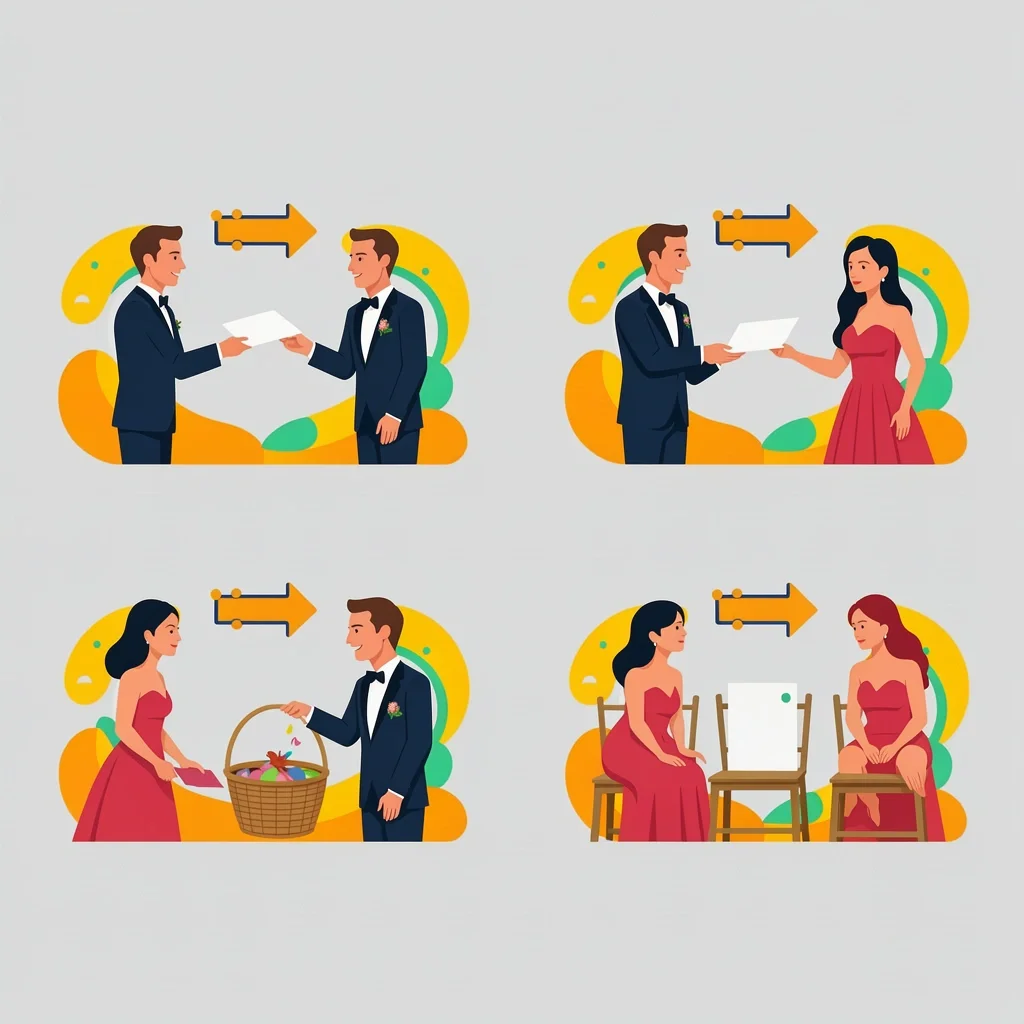
Let me tell you a story. A friend of mine had her two nephews, both seven years old, handing out programs at the ceremony entrance. She told them to “make sure everyone gets one.” Those kids took it literally. They handed a program to every single person — including the bride’s mother, who already had one. She ran out before half the guests arrived. The lesson: instruct your ushers clearly.
- Usher hands to every person: This method guarantees high consumption. Order 1 per guest plus a 5–10% buffer. If your usher is a kid or prone to enthusiasm, lean toward 10%.
- Usher hands to each couple: Works well for traditional weddings where you expect couples to share. But you must account for single guests separately — they need a program too. For this method, I use the formula: (number of couples × 1) + (number of single guests × 1) + 5% buffer.
- Pre-placed on seats: Most guests take the program from their seat and may also grab one from an empty seat nearby. Order the same as your guest count plus 5 extra for each 50 guests to cover that “borrowing.”
- “Take one” basket: This is the most cost-effective. Guests tend to take only what they need, and fewer people grab one overall. I’ve seen consumption as low as 1 per 2 guests. Use 1 per 1.5 guests as a safe middle ground.
Critical Consideration – Modern Wedding Demographics
This is where most advice falls apart. The old rule — “the wife takes one, the husband doesn’t” — assumes a heterosexual, traditional couple dynamic. That doesn’t fit many weddings today.
My rule: Plan for one program per person, not per couple, unless you are absolutely certain your ushers will distribute only one per couple and you’re okay with some people not getting one. If you’re not sure, default to 1 per guest. The extra few dollars are worth avoiding the awkwardness of a guest holding no program while their partner reads one over their shoulder.
Also consider children. If you have kids aged 10 and under, they usually don’t need their own program — but some will grab one anyway. I recommend ordering 1 program for every 3 kids under 12, then adding that to your total. If you have activity booklets or kids’ programs, treat those separately.
Special Cases – Micro Weddings, Destinations, and Ceremony-Only Events
Micro Weddings (under 30 guests)
When you can see every guest, the math changes. Order 1 per guest plus 2–3 extra for the couple’s own keepsakes. Because the guest list is tiny, you can afford a few extras, and you’ll want to keep one yourself.
Destination Weddings
Guests at a destination wedding are more likely to take programs as souvenirs — they’re part of the travel memory. I recommend ordering 15–20% above your guest count. If your program has the destination map or a fun quote, expect even more grabs.
Ceremony-Only Attendees
If some guests only come to the ceremony and skip the reception, they may take a program but leave it behind afterward. You can order fewer because those programs won’t be carried away — they’ll be left on seats. But still have enough for every seat. Use the baseline guest count for the ceremony only, not the reception headcount.
Frequently Asked Questions
How many programs do I need for a wedding with a lot of children?
If you have 20 or more kids under 12, I suggest ordering 1 program for every 3 children plus a few extras. Alternatively, create a simple children’s activity page and count that separately — then you can reduce the adult program count by about 5%. Most kids under 5 won’t take a program unless their parent hands it to them.
Can I print half the programs and share a digital version for the rest?
Yes, but only if you communicate it clearly. Print enough for about 60–70% of guests and place a small sign with a QR code at the ceremony entrance. Send the digital link in your wedding website or email reminder, too. This works best for younger guest lists. For older guests who may not scan QR codes, keep extra physical copies on hand.
Should I order extra programs for the rehearsal dinner or welcome party?
Only if your program includes the rehearsal dinner details — like timeline or location. Otherwise, order separate printed material for that event. Don’t double-count programs for two events. If you do use the same program, order about 10 extra for the welcome party guests who didn’t attend the ceremony.
What if my program also doubles as a fan or a seed packet?
These types of programs have a high souvenir rate. Guests grab them even if they don’t plan to use them during the ceremony. Order 1 per guest plus 10–15% extra. For a fan program at an outdoor summer wedding, I’ve seen people take an extra to cool off — bump that to 20% extra.
There you have it — a repeatable, flexible method for knowing exactly how many wedding programs to order. Start with the number of attending guests, adjust for distribution method and guest makeup, then add a buffer that matches your program style and ceremony setting. You’ll have just enough programs in hand, with nothing wasted.
Many of the same principles apply when you’re ordering wedding invitations from Minted, especially for planning guest counts and buffers.
Our wedding planner was in charge of preparing the program for my wedding, and I thoroughly enjoyed everything that took place on that special day. It’s a good thing that the staff at Victory North Savannah ) is also quite supportive of some immediate changes.
That makes all the difference when the venue is supportive of last-minute changes!