
I remember standing in the lobby of the hotel the night before my sister’s wedding, phone in one hand, walkie-talkie in the other, and a bridesmaid crying because she didn’t know if she was supposed to bring her own makeup or if a professional was coming. The groom’s mom was texting me about the cake pickup, the best man hadn’t replied to any messages in three hours, and the caterer was asking where to unload. That was the moment I realized: a wedding weekend isn’t just a celebration – it’s a communications crisis waiting to happen unless you engineer it on purpose.
After that disaster, I took what I learned and applied it to my own wedding and three others I helped coordinate. The difference between a smooth weekend and a chaotic one comes down to three things: alignment (everyone works from the same facts), authority (every decision has a clear owner), and accessibility (information lives where people can actually find it when they need it). Here’s exactly how to set that up.
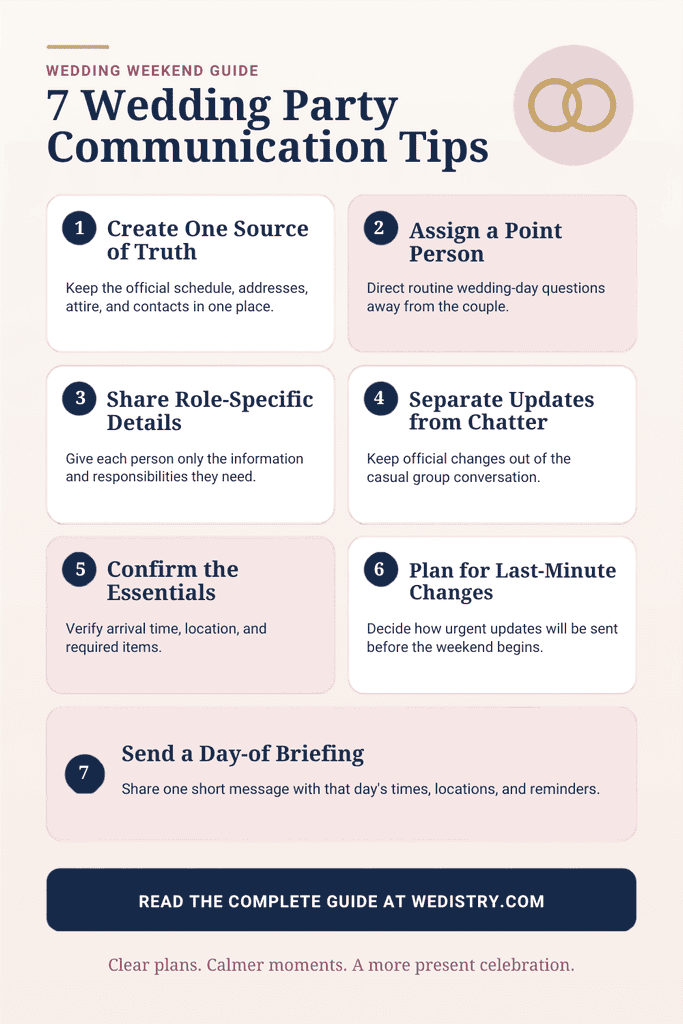
The Decision Ladder – Assigning Authority Before Anyone Needs It
Group consensus is poison during a wedding weekend. When the maid of honor, the mother of the bride, and the groom all have different opinions on whether to move the ceremony indoors because of rain, nothing gets done. You need a decision ladder.
Here’s the hierarchy I now use:
- The Couple – final say on anything that changes the experience (venue, timing, vows).
- The Point Person – one person who owns the entire weekend flow. This can be a day-of coordinator or a trusted friend who is not in the wedding party. The couple does not field vendor calls or guest questions; the Point Person does.
- Dedicated Leads – one person for family logistics, one for vendors, one for the wedding party. Each lead can make decisions within their domain without asking the couple.
- Everyone else – wedding party members, family, guests. They direct questions to their designated lead, not to the couple.
I learned this the hard way when my own wedding coordinator quit two weeks out. I put my sister-in-law in charge of vendors and my best friend in charge of the wedding party. I gave them one rule: if you can solve it without changing the schedule or costing more than $100, do it. If not, come to me. That simple filter saved me dozens of interruptions on the day itself.
The Master Briefing – One Document That Ends Confusion
When information lives in six different text threads, someone will miss something. The solution is a single Master Weekend Brief – a document that contains everything anyone needs to know. I put mine in a shared Google Doc that everyone could access from their phone, plus printed copies for grandparents and tech-averse guests.
What goes in it:
- Full schedule with times and locations for every event (rehearsal, welcome dinner, ceremony, reception, farewell brunch).
- Venue addresses, parking codes, and entrance instructions.
- Dress codes for each event (including what the wedding party should wear and when).
- Vendor contact numbers – caterer, photographer, DJ, florist, transportation.
- Emergency numbers (venue manager, local taxi, nearby hospital).
- A timeline of who needs to be where and when – broken down by role (bride, groom, bridesmaids, groomsmen, family).
I share the full briefing two weeks before the weekend, then send a 48-hour refresher that only lists what changed. On each day of the weekend, I send a micro-brief: a simple text with just the key updates for that day. No one reads a wall of text when they’re already stressed.
Group Chat Etiquette That Keeps Everyone Sane
Group chats are the most common tool and the most common failure point. I’ve been in wedding chats with 400 messages in an hour, most of them jokes, memes, and “what time is dinner again?” It drowns real updates.
My rule now: separate channels by function.
- Logistics Chat – must-read, low volume. Only the Point Person posts schedule changes or critical updates here. Everyone else replies privately. If someone has a question, they send it to the Point Person directly.
- Sh*t Talk Chat – for fun, brainstorming, dress opinions, and non-urgent chatter. Anything goes, but nothing urgent lives here.
When a groomsman goes radio silent (which happens more often than you’d think), I use a polite template: “Hey [Name], just need a quick confirmation that you have the suit and know the call time for Saturday. No rush, but reply when you can so we know you’re set.” If they don’t reply in 24 hours, I call. No guilt, just clarity.
The Day-of Communication Tree – Who Talks to Whom, When
On the wedding day, the couple should not be a node in the communication network. The Point Person becomes the hub. All vendor updates go to the Point Person. Family leads relay guest issues to the Point Person. The wedding party communicates outfit or timing problems to their lead, who tells the Point Person.
I set up a vendor check-in schedule:
- Morning of – the Point Person confirms all vendors have arrived on site and have what they need.
- Post-ceremony – a quick check that catering is on track, photographer has the shot list, and transportation is ready for the reception.
- End of night – confirm final payments, pickup times, and that no equipment is left behind.
The couple only hears about major flags – something that changes the timeline or requires a decision. “The florist is 10 minutes late” is not worth mentioning. “The florist lost the bouquet” is.
The Crisis Playbook – When the Weekend Goes Sideways
Every wedding weekend has a moment of panic. The difference is how you handle it. I designate one person as the “calm carrier” – usually the Point Person – whose job is to stay composed and relay information to the couple only after filtering it for severity.
Here are a few real crises I’ve navigated:
- Vendor no-show. The backup plan is already in the Master Brief. If the DJ doesn’t show, the Point Person calls the second-choice vendor (listed in the brief) and transitions to a Bluetooth speaker playlist in the meantime. The couple never knows until after the fact.
- Bridesmaid’s dress rips. The lead for the wedding party has a sewing kit and knows where the backup dress is stored. No need to involve the bride.
- Weather ruins outdoor ceremony. The decision to move inside is made by the Point Person with the venue manager, using a pre-agreed trigger (e.g., if rain is forecasted >30% at ceremony time, move indoors by 10 AM). The ushers communicate the change to guests with a printed sign and verbal heads-up.
The golden rule: never problem-solve where guests can see the panic. All logistics shuffle happens backstage. Guests only receive polished updates.
Saying the Uncomfortable Things – Conflict-Resolution Communication
Telling a bridesmaid she can’t bring her boyfriend to the welcome dinner, or redirecting a parent who keeps suggesting changes, feels awful. But avoiding it makes the weekend worse.
I use a simple three-part framework: State the observation, name the impact, request the change. No blame. Example:
“I noticed you’ve been texting me a lot about the playlist. I appreciate your enthusiasm, but it’s making it hard for me to focus on other things. Could you please run any music ideas by the DJ directly? Here’s his number.”
Timing matters. Never correct someone in front of others. Do it privately, and do it before a deadline – not during the event. The gratitude sandwich (compliment, correction, compliment) works only if it’s sincere. If you’re just padding, skip it and be direct.
Wrapping Up Gracefully – Post-Weekend Communication
The wedding weekend doesn’t end when the last guest leaves. There are final vendor payments to confirm, thank-you notes to send, and logistics to close out. I send one final message to the wedding party and leads within 48 hours:
- Thank yous – specific callouts to each lead for their role.
- Next steps – where to return rented items, how to get reimbursed for expenses, where photos will be shared.
- Debrief – a quick ask: “What worked well? What would you do differently next time?” This helps for future events and shows you value their input.
The no-abandonment principle means the weekend ends with clear closure, not silent questions.
Frequently Asked Questions
Should we hire a professional day-of coordinator just for communication, or can a friend handle it?
It depends on complexity. If you have fewer than 50 guests, a single venue, and no DIY elements, a trusted friend with strong organizational skills can be the Point Person. For multi-venue weekends, multiple vendors, or high-stress family dynamics, hire a professional. A friend may struggle to say no to their own mother or to aunts who want special favors. A professional has no emotional baggage – they just execute the plan.
How far in advance should the full wedding weekend itinerary be shared with the wedding party?
Share the Master Brief two weeks out. That gives people time to ask questions before they’re in travel mode. Send a 48-hour refresher with only the changes. On the day of each event, send a micro-brief (one or two lines) via text. This layered approach ensures no one is overwhelmed and no one misses a critical update.
Is it rude to set boundaries with a wedding party member who keeps asking questions we already answered?
Not at all. Polite redirect: “Hey, the answer is in the Master Brief under ‘Attire’ – here’s a link. If you still have questions after reading it, let me know. Thanks for checking!” This respects their effort while keeping you from repeating yourself.
How do we share information with tech-averse grandparents or older guests?
Print a one-page weekend summary and hand it to them at the rehearsal dinner. Also assign a family lead to call them the day before to confirm timing and logistics. For older guests who don’t use smartphones, a phone tree works: one person calls three people, each of those calls three more. It’s old school but reliable.
Should the couple be on the vendor check-in schedule or completely off the loop on the wedding day?
Completely off the loop for routine check-ins. The Point Person filters everything. The couple should only hear about something that changes the experience – like a venue fire or a medical emergency. Everything else, the Point Person handles. This is non-negotiable if you want the couple to actually enjoy their day.
Wedding weekend communication feels overwhelming until you build a system. Start with the decision ladder, create one master document, separate your chats, and appoint a calm carrier. Your wedding party will thank you, and you’ll actually get to be present for the moments that matter.