
You are sitting in the parking lot after a session, and you are not sure if you should come back next week. The silence in the car says everything. This is a normal place to be. The decision to continue marriage counseling is not a simple yes or no. It is a question about whether the work you are doing together is moving you toward the relationship you actually want.
Most couples hit a point around session six or twelve where the initial relief of “finally talking” gives way to the harder part: actually changing. This is where people either dig in or walk out. This article is for the ones who want to make a deliberate choice, not an emotional one.
First, Define What “Working” Looks Like

You cannot decide whether to continue marriage counseling until you know what progress means for your specific marriage. Every couple has different goals. For some, progress means stopping a divorce. For others, it means learning how to fight without destroying each other. For many, it means feeling less lonely in the same house.
Here is a practical checklist to run through with your partner before your next session:
- Are your arguments less destructive than they were two months ago? Not less frequent, but less damaging.
- Do you feel heard by your partner during sessions, even if you disagree?
- Is the therapist challenging both of you, or does it feel like one person gets scolded more?
- Have you tried at least one new communication pattern outside of session and noticed a small difference?
- Do you still have hope that the relationship can feel better than this?
If you answered yes to three or more of these, continuing couples therapy is likely the right call. If you answered no to most of them, you need to figure out why before you quit.
The messy middle of counseling is real. Progress in marriage work is rarely a straight line. You will have a good session, then a terrible week at home, then a breakthrough in the next appointment. This rhythm is normal. Do not mistake a plateau for a dead end.
Common Reasons Couples Consider Stopping – and How to Tell Which Ones Are Valid
There are real reasons to stop marriage counseling. There are also reasons that look legitimate but are actually fear or exhaustion in disguise. Let us separate them.
Valid reasons to stop or change course
- The therapist is not neutral. If you feel consistently blamed or ganged up on, that is a real problem. Address it directly with the therapist first. Ask: “Do you see our contributions to the issues differently than we do?” If the bias continues after you raise it, it is time to find someone else.
- One partner has checked out completely. Counseling only works when both people are willing to try. If your partner has genuinely decided the marriage is over, continuing sessions is just a way to delay the inevitable. You will feel it in the room: one person participates, the other waits for the clock to run out.
- Financial strain outweighs the benefit. If you are skipping bills or going into debt for sessions, that itself creates new resentment. Consider spacing sessions to every three weeks or switching to a more affordable therapist before quitting entirely.
Reasons that often mask fear or fatigue
- “We are not getting anywhere.” Sometimes this means you have not done the homework. Therapy requires work between sessions. If you are waiting for the sixty-minute appointment to fix everything, you will always feel stuck.
- “It feels worse now than before we started.” This can be a good sign. Bringing hidden issues into the light often hurts before it heals. The difference between productive discomfort and harmful escalation is whether you feel safer after the session ends or more attacked.
- “We already fixed our main problem.” Many couples solve the presenting issue (like infidelity or a specific argument pattern) and assume they are done. But the underlying habits that caused the problem may still be there. Use two or three sessions to consolidate gains before stopping.
How to Have the “Should We Continue?” Conversation

The worst time to decide whether to continue marriage counseling is right after a session. You are emotionally raw. Make the decision at home, on neutral ground, with a clear structure.
Follow these steps:
- Schedule a private check-in with your partner. No therapist present. Go for a walk or sit in a coffee shop. Give yourselves 30 minutes. No phones.
- Use a simple rating system. Each of you rates three things on a scale of 1 to 10: how much progress you feel you have made, how much effort you are putting in, and how much hope you have for the future. Share your numbers without defending them. Just listen.
- Identify one specific change to try. Instead of a vague “keep going,” agree on one concrete shift for the next two or three sessions. For example: “We will each do the homework assignment before our next appointment” or “We will ask the therapist to focus more on communication tools and less on processing past hurts.”
- Set a review date. Mark your calendar for two sessions from now. At that point, you will re-rate your numbers and decide again.
Once you and your partner have a sense of where you stand, bring it to the therapist. Here is a script you can use:
“We are unsure if this is still right for us. Can we talk about our progress and options? We want to understand what you see as the next milestone and whether there is a different approach we should try.”
A good therapist will welcome this conversation. If they get defensive or dismissive, that itself tells you something.
When the Answer Is “No” – Alternatives to Continuing Traditional Weekly Sessions
Maybe you decided that continuing weekly sessions is not the right path. That does not mean you are giving up on the marriage. It means the current format is not working. Here are other options to consider before walking away from therapy entirely.
Switch therapists
The most common reason couples stop making progress is a poor fit with the therapist, not a hopeless marriage. Different therapists have different styles. Some are more directive. Some are more reflective. If you feel stuck, try one session with a different therapist for a second opinion. Many couples find that a fresh approach unlocks things immediately.
Try a different modality
Standard talk therapy is not the only option. Gottman Method focuses on building friendship and managing conflict. Emotionally Focused Therapy (EFT) targets attachment patterns. Imago Therapy works on childhood wounds showing up in the relationship. A weekend intensive in one of these methods can sometimes do more than six months of weekly sessions because the work is concentrated.
Take a structured break
If you are burned out, stop for a month. But do not just drift. Agree on a plan: no avoiding hard conversations, revisit a specific book or online course together, and set a calendar date to resume. A break without a plan often becomes a permanent stop.
Spacing sessions out
Instead of stopping completely, go to every three weeks or once a month. This reduces the cost and emotional load while keeping a professional anchor in place. Use the extra time to practice what you have learned.
If you are afraid that stopping means you failed, let that go. Not every therapist-client match works. Not every stage of a relationship needs the same intensity of support. Choosing a different path is not quitting. It is being strategic.
What If Only One Partner Wants to Keep Going?
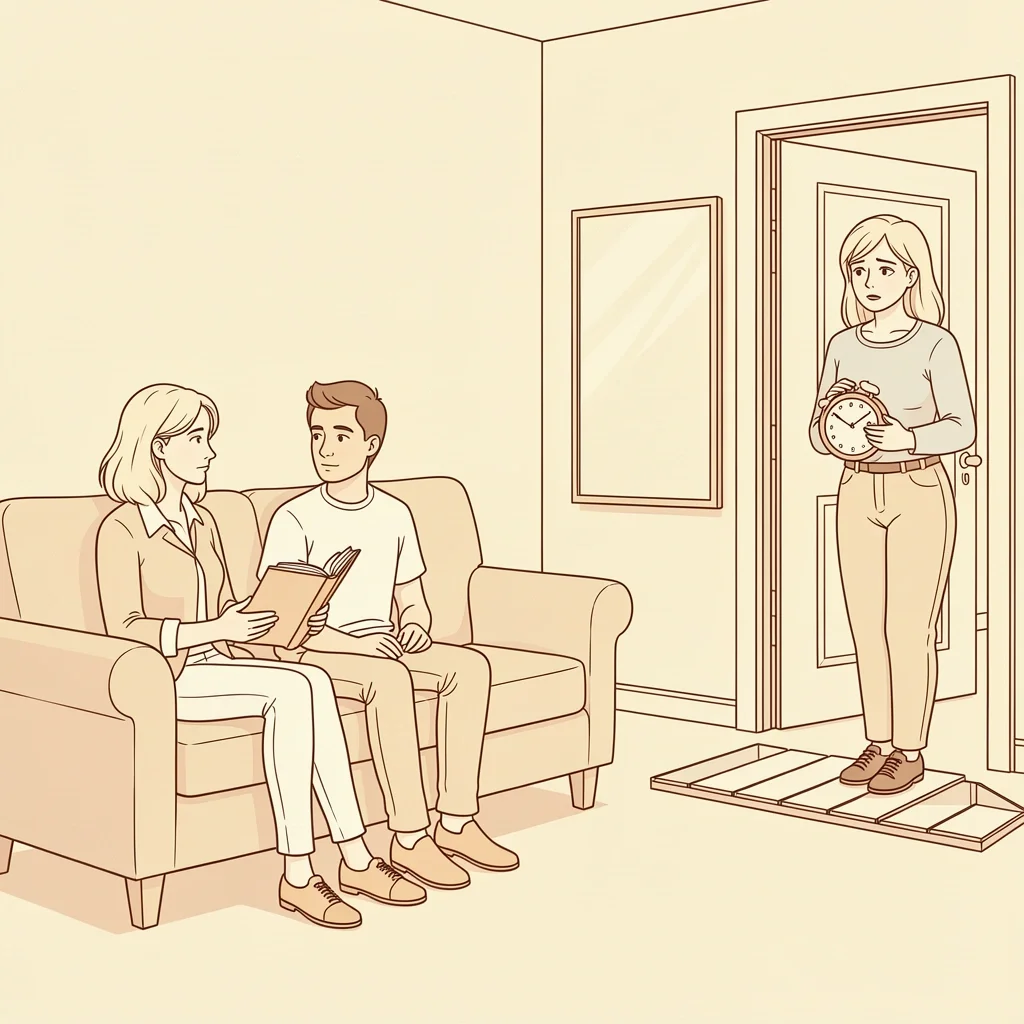
This is one of the hardest situations in couples therapy. When one person wants to continue marriage counseling and the other does not, resentment can build fast. Here is a realistic way to handle it.
First, understand why your partner wants to stop. It might be exhaustion, a feeling that the therapist is against them, or a belief that the marriage is beyond repair. Do not assume it is laziness or lack of commitment. Ask directly: “What would need to be different for you to want to keep coming?”
If they still refuse, you have two paths:
- Continue alone. You can still attend individual sessions that focus on your side of the dynamic. Learning how to communicate better, set boundaries, and regulate your own emotions will benefit the relationship, even if your partner is not in the room. Many therapists offer individual sessions for couples work, and the progress you make on your own can shift the whole system.
- Set a boundary and a checkpoint. Tell your partner: “I am willing to pause counseling for two months, but we will check in at that point. If nothing has changed in our communication, I need us to try again.” This gives space without surrendering the goal.
If your partner refuses to engage at all and the marriage continues to deteriorate, you have a bigger decision to make. But sometimes the person who wants to stop just needs to feel heard about why they are exhausted. That alone can open the door to continuing on new terms.
The Financial & Emotional ROI of Continuing

Let us talk about money and time honestly. A typical couples therapy session costs between $100 and $250 without insurance. Many couples do 12 to 20 sessions before seeing real change. That is $1,200 to $5,000. It is not cheap.
For couples considering premarital counseling, investing early can prevent many of these costs by building strong foundations.
But compare that to the cost of divorce. The median cost of a divorce in the United States is around $7,000 to $15,000, and that does not include moving, separate housing, legal fees for custody, or the emotional toll on children. Divorce is far more expensive than therapy in almost every case.
Here is a way to think about the value:
| Option | Typical Cost | Time Investment | Potential Outcome |
|---|---|---|---|
| Continue weekly counseling for 4 months | $1,600 – $4,000 | 16 sessions, plus homework | Improved communication and connection |
| Weekend intensive (e.g., Gottman, EFT) | $2,500 – $5,000 | Two to three days | Deep breakthrough in compressed time |
| Online self-guided program (e.g., Lasting, OurRelationship) | $50 – $300 | Self-paced, 4–8 weeks | Moderate improvement with no professional feedback |
| Divorce | $7,000 – $15,000+ | Several months to over a year | End of marriage, potential co-parenting challenges |
If you are worried about the cost of continuing, ask your therapist about a sliding scale. Many offer reduced rates for cash pay. Also check if your insurance covers couples therapy directly. Some plans do, especially if one partner has a mental health diagnosis.
The emotional ROI is harder to measure, but here is a simple question: If you continue and the marriage improves significantly, what is that worth to you? Not in dollars. In peace, in sleep quality, in how you feel when you walk through your front door. That is the real calculation.
Frequently Asked Questions
Is it normal to feel worse before getting better in marriage counseling?
Yes. Many couples experience an increase in tension during the first several sessions. Old patterns are being named and disrupted. The discomfort is productive if it leads to new understanding. It is harmful if sessions end with one person feeling attacked and unsafe. If you consistently feel worse for more than a few sessions without any moments of hope, talk to your therapist about the format, not the goal.
Can I continue marriage counseling alone if my spouse refuses?
Yes, and it often helps. Individual sessions focused on relational skills can reduce your own reactivity, improve how you express needs, and change the dynamic at home. Even if your spouse never comes back, you will have better tools for whatever happens next in the relationship.
How many sessions of marriage counseling are average before seeing results?
Research suggests that noticeable improvement often occurs between 8 and 20 sessions. Some couples see a shift earlier, especially if they are highly motivated and do homework. Use this range as a benchmark, not a rule. If you are past 20 sessions and still feel stuck, it is time to re-evaluate the approach or the therapist.
What should I do if my therapist seems to take sides?
Bring it up directly in session. Say: “I feel like you are seeing my point of view less than my partner’s. Can we talk about that?” A good therapist will welcome the feedback and adjust. If the bias continues after you address it, consult with a different therapist before discontinuing altogether. A biased therapist is a valid reason to change providers, not a sign that marriage counseling does not work.
Does online marriage counseling work as well for long-term continuation?
Research shows that online couples therapy can be equally effective as in-person sessions when both partners are comfortable with the virtual format and the therapist is experienced in delivering it online. The key is having a private space where you can talk freely and a stable internet connection. Many couples find online sessions less stressful because they remove the commute and allow for easier scheduling.