
If you search for a wedding reception playlist online, you will find a lot of flat lists. One hundred songs thrown together with no order. No explanation of why they work. That is not what you need. You need a playlist that moves with your night. A playlist that fills the dance floor during dinner, keeps the energy high during the open dance, and gives everyone a moment to breathe before the last song.
In this guide, I will show you how to build a wedding reception playlist that actually works. You will learn the four phases of the night, how to manage crowd energy, and how to share your list with a DJ or band. By the end, you will have a system, not just a list.
The Four Phases of a Reception Playlist
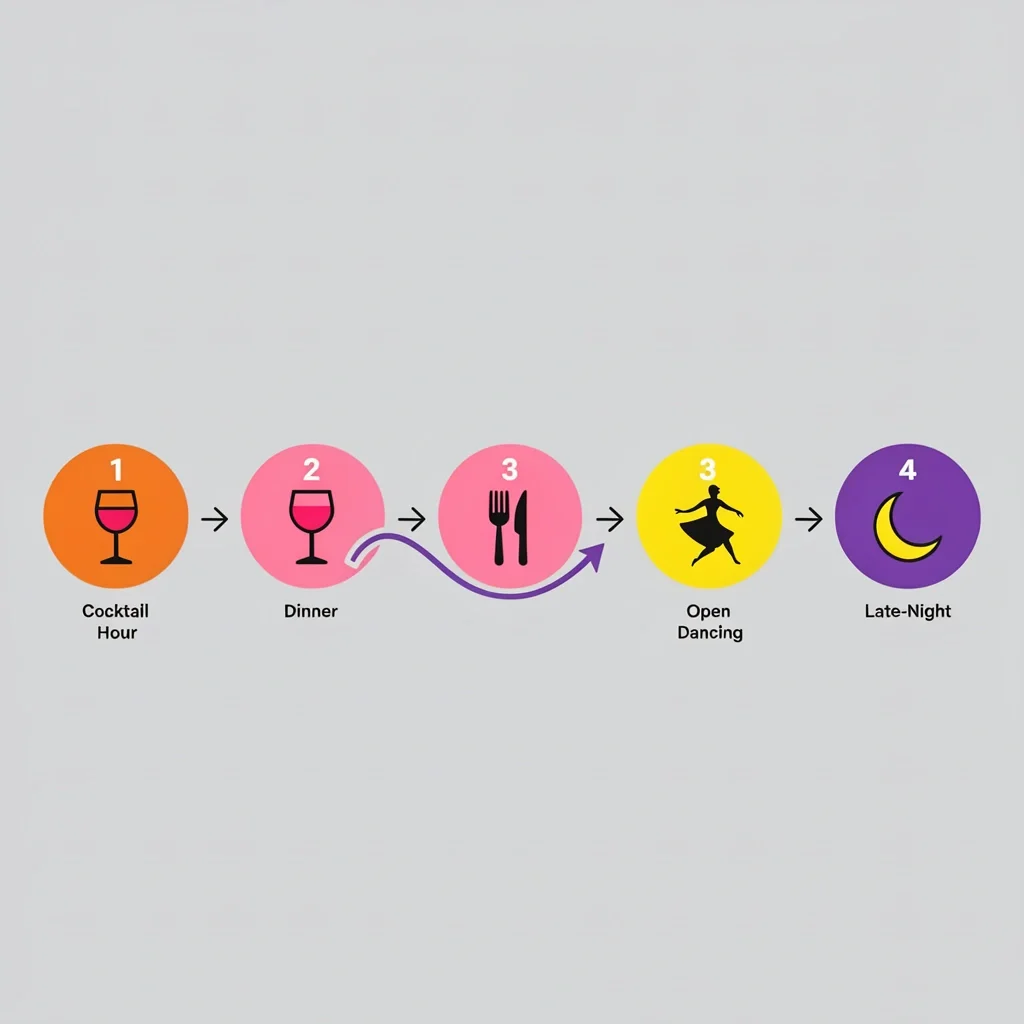
A single playlist cannot cover cocktail hour, dinner, dancing, and late-night. Each phase has a different goal. The music must match. Here is a quick overview of how many songs you need for each phase based on a four-hour reception.
| Phase | Duration | Number of Songs | Main Goal |
|---|---|---|---|
| Cocktail Hour | 60 minutes | 12–15 | Background, light, conversational |
| Dinner | 60–75 minutes | 15–18 | Ambient, not distracting, romantic |
| Open Dancing | 90–120 minutes | 25–35 | High energy with planned lulls |
| Late-Night | 30–45 minutes | 8–12 | Fun, easy, singalong |
Total songs needed: 60–80. Adjust based on song length and whether you want a DJ to fill gaps.
Cocktail Hour Playlist
During cocktail hour, guests are mingling, taking photos, and having drinks. The music should be pleasant but not demanding. Choose instrumental jazz, acoustic covers, or soft indie. Avoid anything with a strong beat or lyrics that pull attention. Keep it at a low volume.
Sample songs: “Moon River” by Audrey Hepburn, “Here Comes the Sun” by The Beatles (acoustic version), “By Your Side” by Sade. Aim for 12–15 songs that flow smoothly.
Dinner Playlist
Dinner is still about conversation. The music should be recognizable but not singalong level. Use romantic classics, soft pop, or light R&B. Avoid anything that makes people want to get up and dance. The goal is to create a warm background.
Sample songs: “Can’t Help Falling in Love” by Elvis Presley, “Your Song” by Elton John, “At Last” by Etta James. Keep the volume lower than you think you need.
Open Dancing Playlist
This is the main event. The open dance floor needs energy peaks and valleys. If you play non-stop bangers, the crowd will burn out after 45 minutes. You need to build energy, then drop it for a slow song or a breather, then build again. This is called the energy curve.
Start with a medium-tempo song that everyone knows, like “September” by Earth, Wind & Fire. Then move to higher energy: “Uptown Funk” by Bruno Mars, then “I Wanna Dance with Somebody” by Whitney Houston. After three or four high-energy songs, play a slow song like “At Last” to let people catch their breath. Then repeat.
Include a mix of genres: line dances, throwbacks, and current hits. But always watch the crowd. If the floor is empty, switch to a proven crowd-pleaser like “Sweet Caroline” or “Mr. Brightside.”
Late-Night Playlist
By the end of the night, the energy is lower. Guests are tired but still want to enjoy the last moments. Use fun, easy songs that everyone can sing along to without needing to dance hard. Think “Don’t Stop Believin'” by Journey, “Closing Time” by Semisonic, or “Piano Man” by Billy Joel. Keep it light and nostalgic.
Energy Management on the Dance Floor
A great DJ balances current favorites with the most-played songs at weddings that consistently bring guests to the dance floor.. By the end of the second hour, half the guests were sitting down. The key is to plan the energy curve. Here is how to do it.
And if you want the entire day to feel as polished as that playlist, running a smooth wedding rehearsal is just as important—it helps the wedding party know their cues and keeps everyone calm before the big moment.
First, understand that a dance floor needs a warm-up. The first 15 minutes of open dancing should be songs that get people out of their seats. Think “Shout” by The Isley Brothers or “Twist and Shout” by The Beatles. These are easy to dance to and require no skill.
After the warm-up, build to a peak. Use songs like “Yeah!” by Usher or “Low” by Florida. Then drop to a slow song. This is the “breath song.” It gives people a chance to grab a drink, sit down, or slow dance. After the breath song, build again. Repeat this pattern three to four times during the dancing phase.
If the dance floor is empty, do not panic. Switch to a song that everyone knows the words to. “Sweet Caroline” works almost every time. If that does not work, try a line dance like “Copperhead Road” or “The Wobble.” These songs have built-in moves that make people feel confident.
How to Share Your List with a DJ
A common mistake is giving the DJ a list of 60 songs and saying “play these.” That kills the DJ’s ability to read the room. Instead, build a tiered playlist.
- Tier 1: Must-play songs. These are non-negotiable. Keep it to 10–15 songs. This includes your first dance, father-daughter dance, and any special songs.
- Tier 2: Play if the vibe fits. This is your main list of 30–40 songs. The DJ will use these as a starting point but can skip or rearrange based on the crowd.
- Tier 3: Emergency fills. These are songs you like but are not essential. The DJ can use them if the floor is empty or if they need a quick transition.
Share your list with the DJ at least two weeks before the wedding. Include notes about the order of special dances. Also, let them know if there are any songs you absolutely do not want to hear. A good DJ will work with you to create a custom set.
Myth vs. Reality About Must-Play Songs
Myth: You need a long list of must-play songs to control the music.
Reality: A rigid list of 50 songs kills the DJ’s ability to read the room. You only need 10–15 non-negotiable songs. The rest should be flexible. If you trust your DJ, let them adapt. If you are using a streaming service playlist, you need a designated person to watch the dance floor and adjust the playlist in real time. A playlist cannot read the room.
Myth: The same songs work for every wedding.
Reality: Your crowd matters. If most guests are older, focus on Motown, classic rock, and oldies. If most are younger, lean into current pop and hip-hop. For mixed-age weddings, choose songs that cross generations. “September” by Earth, Wind & Fire works for everyone. “Sweet Caroline” works for everyone. “I Wanna Dance with Somebody” works for everyone.
Advanced Optimization for Mixed-Age Weddings
Mixing genres and age groups is the hardest part of building a wedding reception playlist. The goal is to keep everyone happy without making the music feel disjointed. Here is a strategy that works.
Start with a bridge song. A bridge song is a track that appeals to both young and old. For example, “Uptown Funk” is loved by grandparents and teenagers. “Shout” is another good bridge. After the bridge, you can move into a genre-specific block. Play two or three songs for one group, then use another bridge to transition to the next group.
Example sequence: “September” (bridge) → “Uptown Funk” (bridge) → “I Wanna Dance with Somebody” (older crowd) → “At Last” (slow song) → “Yeah!” (younger crowd) → “Low” (younger) → “Sweet Caroline” (bridge) → repeat.
This keeps the flow smooth and prevents any one group from feeling left out. Avoid sudden genre switches. For example, do not go from country line dancing directly to hip-hop. Play a bridge song in between.
Frequently Asked Questions
How many songs do I need for a 4-hour reception?
You need 60–80 songs. This depends on song length and whether you allow a DJ to fill gaps. If you use a playlist, have at least 80 songs ready in case the reception runs long.
Should I include a first dance song in the playlist?
Yes, but separate it from the open dance rotation. The first dance is a dedicated moment. It should be cued separately and not played during the open dance. Share it with your DJ or put it as the first song in your dinner phase (if you are doing it after dinner).
What if my guests are mostly older or mostly younger?
Focus on the middle ground. Use songs that have cross-generational appeal. “Sweet Caroline,” “Shout,” “I Wanna Dance with Somebody,” “September,” and “Don’t Stop Believin'” work for almost everyone. Avoid songs that are very niche. Test your list with a few older relatives and a few younger ones to see if they react well.
Can I use a streaming service playlist instead of a DJ?
You can, but you need a designated person to manage volume, transitions, and handling requests. A playlist alone cannot read the room. If someone makes a request, your person must decide whether it fits the flow. Also, you need a backup plan for technical issues. A DJ brings experience and equipment. If you go the playlist route, practice the transitions beforehand.
What is the best way to handle requests?
Create a request card or a shared digital doc. Ask guests to submit requests at least two weeks before the wedding. On the night of, the DJ or person managing music should have discretion to decline requests that break the flow. If a request is a Tier 1 song, play it. If it is a random obscure song, it is okay to say no.
The wedding reception playlist adds to the celebration’s beauty. I’ve chosen a few songs that will be performed at my wedding. I was overjoyed when the staff at Victory North Savannah ) surprised us by playing our wedding theme song.
It’s so much fun to create a wedding reception playlist that you know will be enjoyed by your family and friends.