

If you have recently started planning a wedding, you have probably felt it. That moment when a venue quote arrives and it is five times what your parents paid. When a photographer tells you the package starts at three thousand dollars for a single day. When your mother says, “Well, we did it for two thousand in the seventies,” and you wonder whether you are being ripped off or if the world has simply gone insane.
You are not imagining it. Wedding inflation is real, and it is not just regular inflation in a white dress. The average wedding in 1970 cost about $1,600. Adjusted for general inflation, that would be roughly $12,500 today. Yet the average wedding in recent years costs around $35,000. That is a 180 percent real increase after accounting for inflation. Something else is happening. This article explains exactly what that something is, why it happened, and how you can navigate it without losing your mind or your savings.
The Real Cost: How Wedding Inflation Outpaces Everything Else
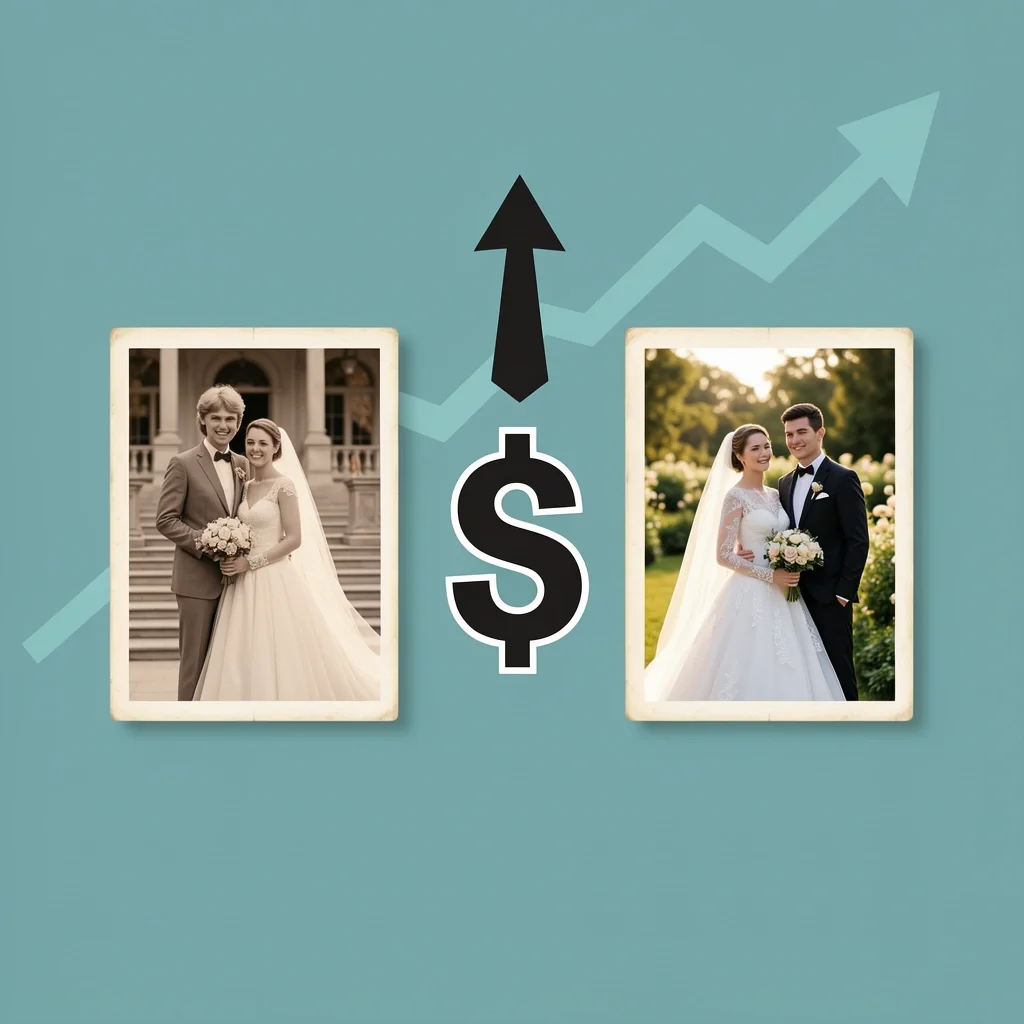
To see the problem clearly, look at how specific wedding expenses have changed compared to general inflation. The table below shows what a typical 1974 wedding cost, what that same amount would be in today’s dollars if it had only kept up with inflation, and what those items actually cost now. (The 1974 numbers come from a real San Francisco wedding that we recreated with current vendor quotes.)
| Category | 1974 Cost | Inflation-Adjusted (Today’s Dollars) | Actual Cost Today | Real Increase Over Inflation |
|---|---|---|---|---|
| Ceremony (large church) | $250 | $1,201 | $7,650 | 537% |
| Photography (professional, one day) | $50 | $240 | $2,500 | 941% |
| Bridal attire (dress, veil, shoes) | $195 | $937 | $1,900 | 102% |
| Flowers (bridal party bouquets only) | $50 | $240 | $1,400 | 483% |
| Catering and reception (300 guests, hors d’oeuvres, limited bar) | $1,200 | $5,769 | $30,128 | 422% |
| Total | $2,095 | $10,068 | $47,286 | 370% |
The numbers are stark. Photography costs nearly ten times what inflation alone would predict. Venue and catering costs have exploded. The only category that stays somewhat close to inflation is the wedding dress. But across the board, the wedding industry has experienced a cost escalation that far exceeds what you see in housing, cars, or groceries. So what caused it?
Three Forces Driving Wedding Costs Higher
Wedding inflation is not a mystery. It comes from three separate economic and social forces that have been building for decades. Each one reinforces the others.
The Professionalization of Wedding Vendors

In the 1970s, most wedding services were provided by amateurs or semi-professionals. The photographer was a neighbor with a nice camera. The cake was baked by a talented aunt. The florist was a local shop that did a few weddings on weekends. Those vendors had low overhead, no insurance, no formal training, and no need to charge full market rates.
Today, nearly every wedding vendor is a full-time professional. Photographers carry tens of thousands of dollars in equipment, carry liability insurance, edit images for hours, and often hire a second shooter. Bakers have commercial kitchens, food safety certifications, and design portfolios. Florists rent coolers, maintain relationships with wholesalers, and deliver complex installations. These are real businesses with real costs. The price you pay is not just for the day of service; it covers months of planning, multiple consultations, backups, and the expertise to handle anything that goes wrong.
The effect on wedding inflation is dramatic. A professional photographer in 1975 might have charged $50 for a wedding. That was not a bargain — it was the market rate for a skill that was not yet a full career. Today, the same level of professionalism requires a fee that covers the real cost of running a business. The service you get is fundamentally different, and so is the price.
The Expectation Escalation Cycle
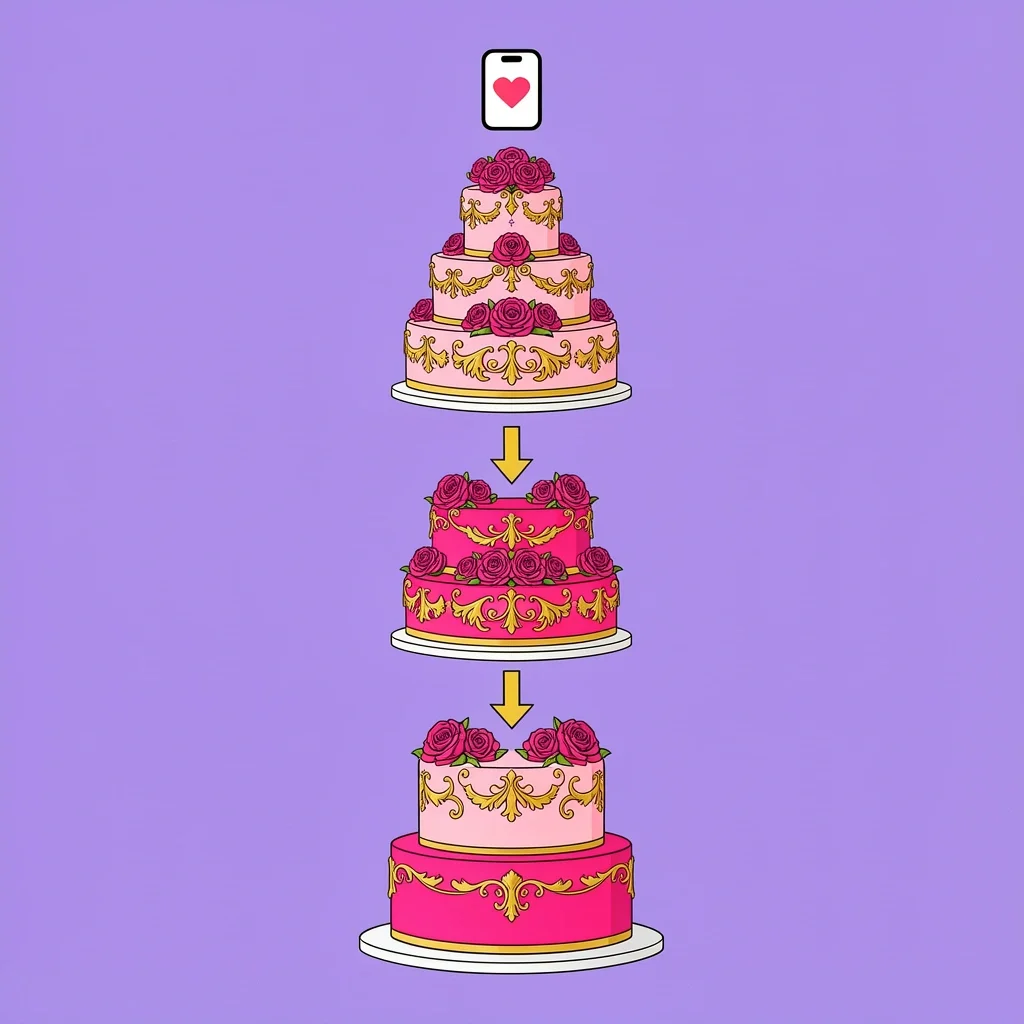
Social media, Pinterest, and wedding television have created a shared visual standard for what a wedding “should” look like. Couples now compare their wedding not to their parents’ wedding, but to the most polished, curated images they see online. This has created a prisoner’s dilemma: no individual couple needs a four-thousand-dollar floral budget, but when every wedding on Instagram has elaborate centerpieces, a flower wall, and a ceremony arch, the baseline shifts upward.
Consider the number of “must-have” items. In 1975, a typical wedding had about three or four special details: a cake, flowers, a photographer, and a dress. Today, couples routinely budget for ten to fifteen line items: videographer, photo booth, welcome bags, rehearsal dinner, day-after brunch, specialty lighting, live musician, favors, personalized signage, and more. Each addition comes with its own cost and its own vendor. This expansion of what is considered necessary has added thousands of dollars to every wedding budget, and it shows no sign of reversing.
The wedding industry has been “assiduous in working to establish the trappings of the lavish formal wedding as if they were compulsory rather than optional,” as Rebecca Mead wrote in One Perfect Day: The Selling of the American Wedding. Once an item becomes normal, it becomes hard to skip without feeling like your wedding is incomplete. That is the expectation escalation cycle, and it is a major driver of wedding cost inflation.
The Macroeconomic Squeeze on Service Labor
General inflation in the service sector has been consistently higher than inflation in goods. Services like catering, photography, and planning are labor-intensive and difficult to automate. They also rely on workers who are increasingly scarce in many regions. The labor shortages in restaurants and event hospitality have pushed wages up, and those costs get passed to clients.
Venue costs track real estate values, which have risen sharply in most metro areas. Catering costs are driven by both food prices and kitchen labor. Photography costs include not just the photographer’s time but also software subscriptions, cloud storage, and marketing. Insurance premiums for event vendors have also climbed. All of these macroeconomic pressures compound specifically on wedding vendors because they sell time, expertise, and customization rather than mass-produced products. According to Bureau of Labor Statistics data on personal services categories, the cost of event services has risen about 40 percent more than general consumer goods since the year 2000. That is not a blip; it is a structural shift.
Wedding Inflation Is Not the Same Everywhere
National averages hide extreme variation. The same wedding that costs $50,000 in San Francisco might cost $15,000 in rural Ohio, even after adjusting for general cost of living. That is because wedding costs are tied to local real estate, local labor markets, and local competition.
In major coastal cities, the wedding industry is hyper-competitive and saturated with premium vendors. Venues charge based on the value of the land. Photographers and planners have high overhead because rent and living costs are high. In smaller cities and rural areas, the same line items are often available for a fraction of the price. This does not mean you should move your wedding — but it does mean you should be careful about trusting national averages. If you are planning a wedding outside a major metropolitan area, your budget can go much further. A national wedding inflation rate of 370 percent does not apply equally to a barn wedding in the Midwest and a hotel ballroom in Manhattan.
The regional reality check is important because it prevents couples from feeling defeated by headlines meant for the entire country. If you live in a lower-cost area, the numbers that shock you may not reflect your actual experience. Use local vendor quotes, not national data, to set your expectations.
How to Budget Given the Reality

Once you understand why weddings are so expensive, the next question is what to do about it. The most effective strategy is not to haggle with every vendor or cut every cost to the bone — that path leads to frustration and a wedding that feels stripped down. Instead, focus on reducing the number of “must-have” line items.
A $10,000 wedding in the current market is possible if you limit yourself to three or four major expenses. Choose a venue that includes catering and basic decor. Hire a photographer for six hours instead of twelve. Skip the videographer. Use a simple cake from a local bakery. The key insight is that the cost of each individual line item is less flexible than the total number of line items. You can negotiate a little, but you cannot negotiate a photographer down to $500 if the market rate is $2,500. What you can do is decide that you do not need a photo booth, a live band, a flower wall, and a welcome party. Each elimination saves you the full cost of that vendor.
Prioritize the guest experience over decorative details. People remember the food, the music, and the feeling of being welcomed. They do not remember the color of the napkins or the number of centerpieces. Spend your money on the things that make people feel cared for, and spend less on things that only appear in photographs.
Frequently Asked Questions
Did the pandemic permanently inflate wedding costs?
The pandemic created a backlog of postponed weddings and a surge in pent-up demand. Many vendors raised their prices in 2021 and 2022 because they could — couples were desperate and willing to pay. Some of those increases have stuck, especially for vendors who lost income during lockdowns and now price their time higher to compensate for future risk. However, the most dramatic price hikes have softened since 2023. The lasting effect is that many vendors now include force majeure clauses and nonrefundable deposits, which add to the cost structure. The overall baseline is higher than it was in 2019, but not as high as the peak in 2022.
Is there a “wedding tax”? Do vendors charge more just because it is a wedding?
Yes, but it is usually not arbitrary. Wedding work is more demanding than corporate events. Weddings have higher emotional stakes, longer hours, and a need for perfection that corporate clients rarely demand. Vendors also face higher opportunity costs: a wedding takes up a full day plus prep time, and they can only book one per weekend. Because couples are often less price-sensitive than corporate clients, wedding prices tend to be higher. However, some vendors do charge an unjustified premium just because the word “wedding” appears. The best way to check is to ask for a quote for a similar event (like a milestone birthday or anniversary party) and see if the price changes. If it does, that premium may be negotiable.
How does wedding inflation compare to other major celebrations?
Wedding inflation is higher than inflation for bar mitzvahs, quinceañeras, milestone birthdays, and other large parties. The reason is the expectation cycle. Weddings have a unique cultural pressure to be “perfect” and a longer lead time for planning, which allows vendors to charge more. Bar mitzvahs and quinceañeras are also expensive, but they rarely include the same number of line items — no photographer for fourteen hours, no elaborate floral installations, no multi-tier cake with custom design. Weddings sit at the top of celebration inflation because they are the most elaborate and emotionally charged event most people ever plan.
What is the single biggest driver of wedding cost increases over the past 50 years?
The single biggest driver is the combination of vendor professionalization and the expansion of must-have line items. If you had to pick one, it would be the shift from a DIY, community-based event to a professionally produced one. That shift accounts for the majority of real cost increases, because it transformed every aspect of a wedding from a favor or exchange into a market transaction with a trained specialist. The expectation escalation cycle then multiplied the number of specialists. Together, they explain why costs have risen so far beyond general inflation.
If you’ve ever wondered why wedding food is so expensive, this same professionalization hits the catering side just as hard, with specialized chefs and custom menus driving up the bill.
How can I spend what my parents spent in real terms?
To match your parents’ spending in real terms, you need to target about $12,000 to $15,000 in current dollars, depending on when they married. That is possible, but you must limit yourself to the same number of line items they had. In practical terms, that means a simple ceremony, one photographer for a few hours, a simple dress, a single bouquet, and a reception with basic catering and a one-tier cake. You cannot add a videographer, photo booth, specialty lighting, or welcome bags without exceeding the budget. The discipline is not about finding cheap vendors — it is about having fewer vendors. That is the honest way to pay what your parents paid, and it still yields a beautiful wedding if you focus on what matters most.
Wedding inflation is real, measurable, and driven by structural forces that are not going away. But understanding those forces gives you power. You know why the quotes are high. You know where the premium comes from. And you know that you can still have a great wedding without spending a fortune — as long as you are intentional about what you include. That is the difference between feeling ripped off and feeling informed. Go plan with that clarity.