

You have probably heard the same advice a hundred times: “Just live in the moment.” “Don’t sweat the small stuff.” “It goes by fast, so soak it in.” But if you are already worried that you won’t enjoy your wedding, those platitudes feel hollow. The real problem is that most couples treat enjoyment as something that magically appears on the day. It does not work that way.
Enjoyment is not a feeling that arrives with your dress or your vows. It is a condition you engineer in the weeks and months before the wedding. The couples who genuinely loved their big day did not stumble into it. They made specific choices about how they would show up, what they would protect, and what they would let go. This article walks you through those choices, from the conversations you need to have now to the structural decisions that will let you breathe on the day itself.
Why “Enjoy Your Wedding” Is the Wrong Question to Ask

When you ask yourself “How can I enjoy my wedding?” you are looking for a single feeling. But your wedding day contains dozens of moments, each with its own emotional texture. Some moments will feel joyful. Others will feel stressful, boring, or funny. If you judge the entire day by a single standard, you will miss the small pockets of real joy that are already there.
Many couples confuse “not hating it” with “enjoying it.” They get through the day without a meltdown and call that a win. But relief is not the same as joy. The wedding industry sells you an image of constant bliss, but real human experience is messier. Enjoyment comes from recognizing the moments that matter to you and letting go of the ones that do not.
The reframe is simple: enjoyment is a choice you make in advance. You decide what kind of presence you want to bring to the day, then you build the conditions that make that presence possible.
Define Your Personal Version of a Joyful Wedding
Before you plan a single tactic, you need to know what “enjoying your wedding” actually looks like for you. Most advice assumes that enjoyment means being social, dancing, and making rounds. That works for some people, but not for everyone.
To shift your mindset earlier in the process, learn How to Enjoy Wedding Planning by focusing on what truly matters to you.
Here are three common enjoyment types. See which one fits you.
| Type | What brings joy | Risk on wedding day |
|---|---|---|
| The Connector | Interacting with guests, feeling the energy of the room | Overcommitting to conversations and burning out |
| The Observer | Watching the event unfold, noticing details, feeling the significance | Getting swept away by the pace and missing the big picture |
| The Couple | Shared private moments with your partner, feeling the commitment | Feeling pulled away from each other by hosting duties |
Most people are a mix. The trick is to identify your dominant type and design the day to feed that need. If you are an observer, schedule quiet moments where you can step back and watch. If you are a connector, plan short bursts of social time rather than trying to talk to everyone all night.
The Pre-Wedding Foundation: Building the Conditions for Presence

What happens in the two weeks before your wedding matters more than what happens on the day itself. Your emotional state on the morning of the wedding is the sum of your sleep, nutrition, decision fatigue, and boundary-setting from the previous days. You cannot “flip a switch” and become present if you are exhausted and stressed.
The Two-Week Countdown Protocol
Start 14 days before the wedding. Do these things:
- Prioritize sleep over everything else. Seven to eight hours per night. No exceptions.
- Stop solving new problems 72 hours before the wedding. If a guest cancels or a vendor messes up, let your coordinator or a trusted family member handle it.
- Divide emotional labor. One partner handles family questions. The other handles logistics. Do not swap roles two days before.
Three Conversations Every Couple Needs Before the Wedding
Set aside an hour with your partner. Talk through these three prompts:
- What does “enjoying our wedding” look like to you specifically? One person might describe laughing with friends. The other might describe a quiet moment during the first dance. Write down both answers.
- Where are we willing to disappoint people to protect our experience? Maybe you skip the bouquet toss or choose not to host a welcome dinner. Agree on boundaries now so you do not feel guilty later.
- What is our signal when one of us is overwhelmed? A word or a hand squeeze that means “I need a minute.” Practice it once.
The Pre-Wedding Ritual That Sets the Tone
Your wedding morning sets the emotional baseline for the entire day. Do not fill it with hair appointments and family drama. Build a small ritual that anchors you in the reason you are doing this.
Option one: have a private breakfast together without your bridal party or family. Fifteen minutes of just the two of you, eating something simple. Option two: write short notes to each other that you read right before walking down the aisle. The notes do not need to be long. A few sentences about what you love about this person is enough.
Research on emotional anchoring shows that a calm, intentional morning reduces cortisol levels for hours afterward. Protect that time like you would protect the ceremony itself.
Engineering the Day: Structural Decisions That Reduce Stress and Increase Presence
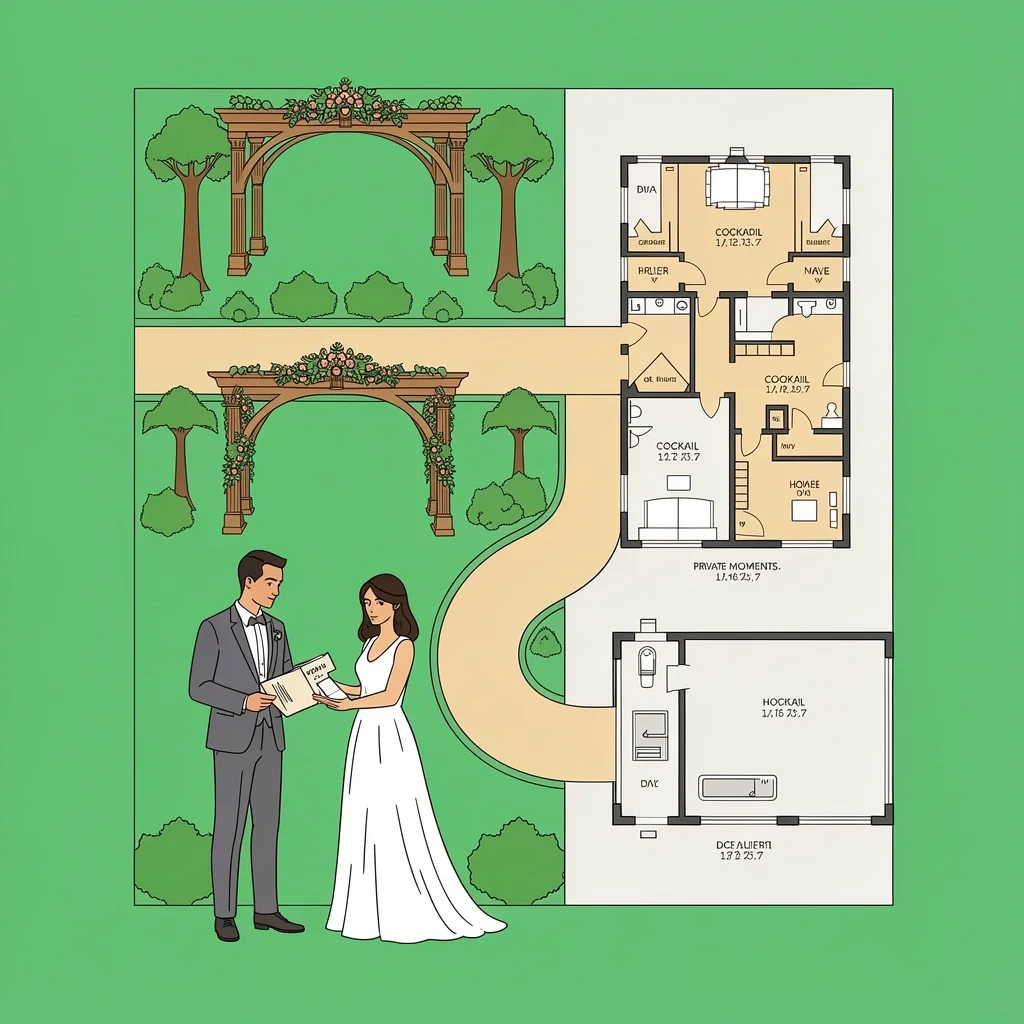
Most wedding advice tells you what to do during the day. This section tells you what to build into the day so you do not have to try so hard. Good structure makes presence automatic.
The Ceremony: Designing for Your Attention, Not Just Your Guests’
A ceremony that rushes through vows in six minutes will leave you feeling like you blinked and missed it. Aim for at least 20 minutes. That gives you time to breathe, to look at your partner, to notice the room. Ask your officiant to pause at key moments so you can take a mental photograph.
An unplugged ceremony (no phones allowed) helps you stay present because you are not wondering if someone is filming your expression. It also reduces pressure to perform for cameras. You are just there.
The Cocktail Hour: Your First Opportunity to Recharge
Cocktail hour is often the most stressful part of the day because couples try to host every guest right after the emotional intensity of the ceremony. Do not do that. Instead, use this time deliberately.
Two strategies: “the disappearing couple” or “the one-pass.” In the first, you spend the entire cocktail hour alone together in a quiet space. In the second, you make one quick round of greetings and then disappear. Both work. Choose based on how much social energy you have left.
You can also use your photographer as an excuse. “We need to take photos” is a polite way to get alone time without anyone feeling slighted.
The Reception: Pacing, Placement, and Permission
The sweetheart table (just the two of you) is often the best choice for couples who want to stay focused on each other. If you are more extroverted, a head table with your bridal party can keep the energy high. Pick the option that matches your enjoyment type from earlier.
Use the “three-touch” rule: plan exactly three meaningful interactions with guests during the reception. Maybe a toast with your parents, a quiet chat with your best friend, and a dance with an elderly relative. That is enough. You do not need to work the room like a politician.
Transition from dinner to dancing is the moment anxiety peaks. To handle it, schedule a slow song for your first dance. Then let your DJ invite guests to the floor. Do not feel forced to stay on the dance floor all night. It is okay to sit out a few songs and just watch.
Give yourself permission to skip traditions that drain you. The garter toss, bouquet toss, and long toasts from distant relatives are optional. If they do not serve your enjoyment, cut them.
The Performance Paradox: How to Be Present When You’re the Center of Attention
Here is the tension no one talks about: you invited people to celebrate with you, and they want to interact. But if you spend the whole day being a host, you never get to be a partner. This is the main reason couples feel like they “managed” the wedding instead of experiencing it.
Use the 70/30 rule. Keep 70 percent of your mental energy for your partner and your own experience. The other 30 percent goes to hosting. Most couples accidentally reverse these numbers. To fix it, designate specific “hosting zones” during the reception—for example, the first 30 minutes after dinner. Outside those zones, you are off-limits. Train your wedding party to protect you. Give one person the job of interrupting conversations when you need a break.
The Post-Wedding Enrichment: Processing the Day Without Regret

Many couples wake up the morning after and feel oddly empty. They look at photos and see themselves smiling, but they remember stress. That gap between memory and reality is normal. It does not mean you did not enjoy the day. It means your brain was too busy to notice the joy in real time.
To close that gap, talk to your partner about the specific moments you remember. Do not ask “Did you enjoy it?” Ask “What was your favorite moment?” and “When did you feel most present?” This shifts the conversation from judgment to exploration. Over time, the positive memories will grow stronger than the stressful ones.
If you genuinely feel like you did not enjoy the day, look for the expectations that caused the disappointment. Did you expect to feel a certain way? Did you compare your experience to someone else’s wedding? Most of the time, the regret is about unmet expectations, not genuine unhappiness.
Frequently Asked Questions
Will I regret not enjoying my wedding?
Most couples who worry about this actually experienced moments of joy—they just did not recognize them in the moment. The regret usually comes from expecting the day to feel perfect. Give yourself permission to have mixed feelings. That is human.
How do I enjoy my wedding if I hate being the center of attention?
Focus on structural decisions. Have a private ceremony with only close family and a larger reception later. Or sit guests in a circle during the ceremony so you are not on a stage. A first look (seeing each other before the ceremony) away from guests can also reduce that spotlight feeling.
What if my partner does not care about enjoying the wedding as much as I do?
This is common and can create resentment. Do not force them to care about the whole day. Instead, ask them to pick one or two moments they want to protect. Maybe it is the first dance or a quiet dinner. Give them ownership of those moments. That is enough.
Can I enjoy my wedding if it is small?
Small weddings often make enjoyment easier because you have fewer demands on your attention. The pressure to “enjoy it more” because you spent less money is the real obstacle. Let go of that comparison. Small can be deeply joyful.
How do I handle guests who demand my attention?
Set expectations before the day. A note in the program or a word from the officiant can help. On the day, your wedding party should run interference. You are not obligated to be available to everyone. Your job is to marry your partner and celebrate in a way that feels right to you.