
You want a beautiful outdoor ceremony, but you cannot control the weather. The question of how hot is too hot for outdoor wedding has a real answer based on safety, not just comfort. Here is the threshold you need: If the heat index (the feels-like temperature) will be 90°F or higher during your ceremony window, it is too hot for a seated outdoor wedding that lasts 20 minutes or longer. For shorter ceremonies under 20 minutes, you can push to a heat index of 95°F, but only if you have shade and drinking water available for every guest.
This is not about being uncomfortable. It is about preventing heat exhaustion and heatstroke. A wedding guest sitting still in direct sun for half an hour has no way to cool down. Their body temperature rises fast. You need a cutoff point, and 90°F heat index is that point for most situations.
The Temperature Number You Need to Know
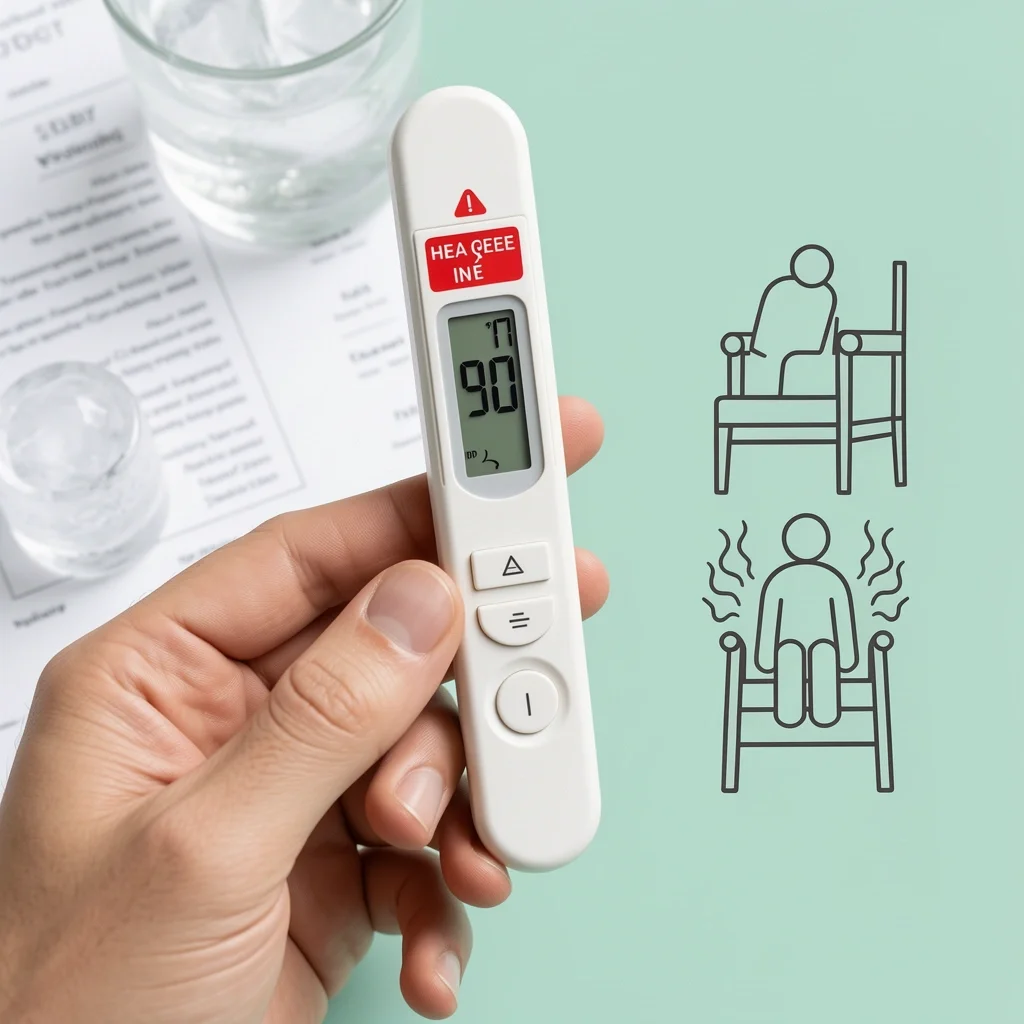
The raw air temperature on the thermometer is misleading. Humidity changes everything. When the air is humid, sweat cannot evaporate from your skin. Your body loses its main cooling mechanism. This is why 85°F with 90% humidity is more dangerous than 95°F with 30% humidity.
Use the heat index instead of the air temperature. The National Weather Service provides a simple chart for this. Here is the breakdown for outdoor wedding safety:
| Heat Index Range | Risk Level | Safe Ceremony Length | Required Conditions |
|---|---|---|---|
| Below 80°F | Low | Up to any length | No special precautions needed |
| 80°F to 89°F | Moderate | Up to 45 minutes | Shade for all guests, water available |
| 90°F to 94°F | High | Under 20 minutes | Shade, water, fans, short ceremony script |
| 95°F and above | Extreme | Under 10 minutes | Misting fans, cooling towels, immediate backup plan |
This table gives you a clear decision tool. Check the heat index for your ceremony time on the day before the wedding. If it falls into the high or extreme range, you need to make changes.
What Makes Heat Feel Worse at Your Venue
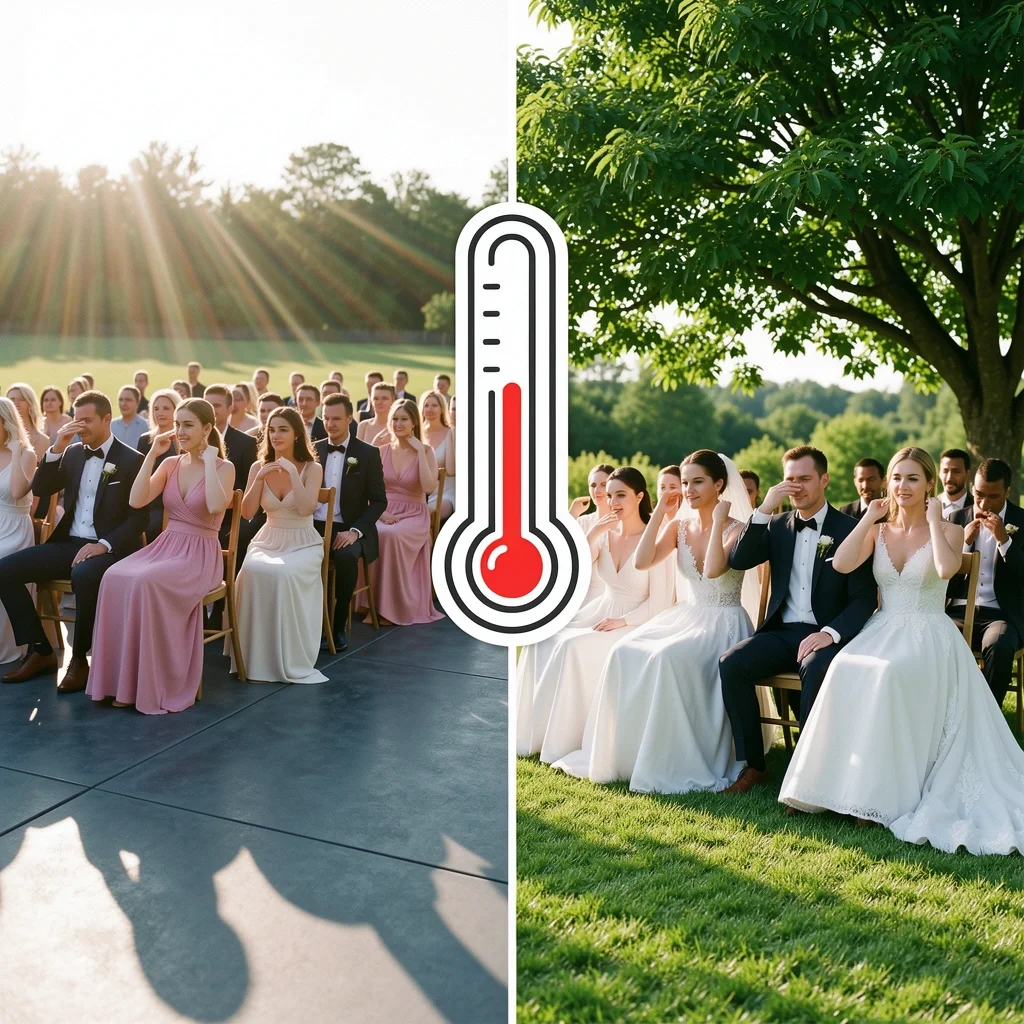
Five factors can push a borderline day into dangerous territory. You need to consider each one before making your final call.
Direct Sunlight vs. Full Shade
Direct sun adds about 15°F to the heat index. A guest sitting in direct sun at 85°F heat index is actually experiencing something closer to 100°F. If your ceremony area has no natural shade from trees or buildings, you are adding this extra heat load to every person. This one factor alone can turn a safe day into a dangerous one.
Ground Surface and Radiant Heat
Dark pavement, concrete patios, and artificial turf absorb heat during the day and radiate it back. Standing or sitting on these surfaces adds 5°F to 10°F to the heat you feel. Grass, dirt, and natural stone stay cooler. If your ceremony is on a dark deck or concrete terrace, the heat will be higher than the forecast says.
Wind and Air Movement
Wind helps cool the body by moving heat away from the skin. Still air with no breeze stops this cooling effect. If your venue is in a sheltered area like a courtyard with high walls, the heat feels worse. Open fields with steady wind feel several degrees cooler.
Time of Day
Peak heat hours run from 10 a.m. to 4 p.m.. The sun is highest during this window, and ground surfaces have had hours to warm up. A 4 p.m. ceremony is risky because the ground is still holding heat from the afternoon. A 5 p.m. or later ceremony gives the ground time to cool, and the sun angle drops, reducing direct exposure.
Ceremony Length and Guest Posture
Guests sitting still in chairs cannot cool themselves by moving or walking. Their body heat builds up with nowhere to go. A 30-minute ceremony feels much hotter than a 15-minute one, even at the same temperature. If you want readings, songs, processions, or long vows, you need to keep the total sitting time short on hot days.
How to Measure and Predict Heat for Your Date
You do not need expensive equipment. Three tools will tell you everything you need to know.
Check the heat index forecast. Go to weather.gov and enter your venue location. Look at the hourly forecast for the exact ceremony time. It will show both temperature and heat index. Do this starting three days before the wedding for the most accurate prediction. Check again the morning of the event.
Use a handheld thermometer. Buy a simple digital thermometer that shows temperature and humidity. Place it in the ceremony area in the shade and in the sun. Read both values. This gives you real data instead of guessing how the forecast applies to your specific spot.
Do a walk test. Stand in the spot where the couple will stand. Stand where the front row guests will sit. Do both at the ceremony time of day. If you feel uncomfortable after five minutes, the heat is too high. Trust your body.
Guest Vulnerability Tiers
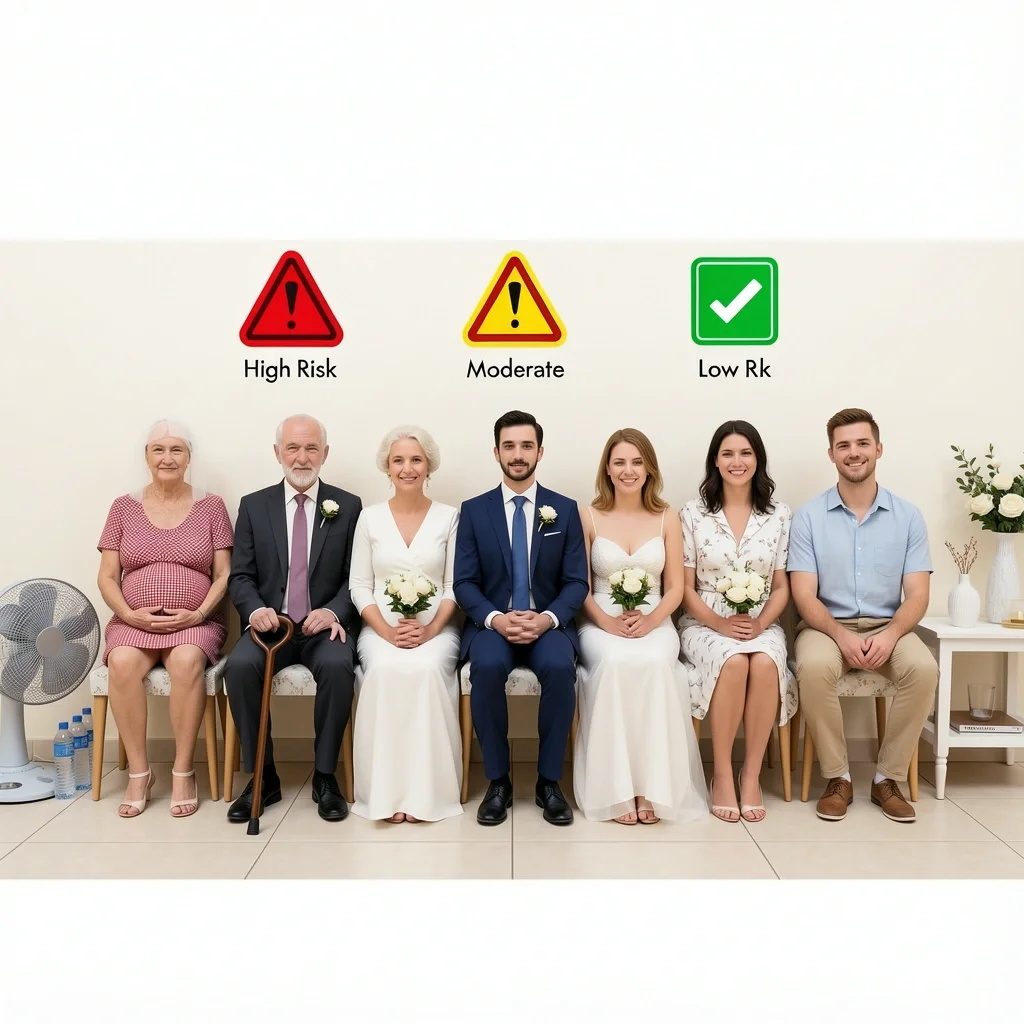
Not all guests handle heat the same way. You need to plan for the most vulnerable people first, because they will get sick before anyone else does.
High Risk: Elderly guests, children under 5, pregnant individuals, people with heart or lung conditions, and anyone on medications that affect heat regulation (blood pressure pills, antidepressants, antihistamines)
These guests can overheat in conditions that feel fine to others. They need priority seating in the shade, near a fan, and within reach of water. If the heat index reaches 85°F, you should have an indoor or shaded waiting area available for them before the ceremony starts. Do not expect them to sit in the sun at all.
Moderate Risk: People who are not accustomed to hot climates, heavy clothing wearers (suit jackets, long dresses), and anyone with a sunburn
These guests will feel the heat faster than the average person. They benefit from cooling towels, handheld fans, and shaded seating. If you see them fanning themselves or sweating heavily during the ceremony, check on them after the ceremony ends.
Low Risk: Healthy adults dressed in light fabrics who are accustomed to warm weather
These guests will be uncomfortable in high heat but are less likely to get sick. They still need water and shade beyond 90°F heat index. Do not assume they are fine just because they are young and fit.
Myths About Outdoor Weddings and Heat
Several common beliefs lead couples into dangerous situations. Here is the reality behind the most misleading ones.
Myth: A dry heat is safe. Dry heat still raises body temperature. At 95°F with 15% humidity, your body works harder to pump blood to the skin for cooling. Heatstroke can happen in low humidity. It just takes slightly longer. Dry heat does not make high temperatures safe.
Myth: A sunset ceremony solves everything. Sunset time is not the same every day. In summer, sunset can be after 8 p.m. The ceremony start time of 5 p.m. is still in peak heat. Direct sun at 5 p.m. in July is strong. The ground is still hot from the day. If you choose a late ceremony, make sure it starts after 6 p.m. when the sun has dropped lower.
Myth: Handheld fans and paper programs are enough cooling. Handheld fans move air, but they do nothing to lower body temperature when the air itself is hot. They provide a small psychological benefit. They do not prevent heat exhaustion. You need actual cooling methods like water, shade, and ice.
Myth: Guests from warm climates can handle anything. Being from a hot place does not make someone immune to heatstroke. People who live in hot climates are more accustomed to the discomfort, but their bodies still overheat at the same internal temperature. A guest from Miami will still get sick at 100°F just like a guest from Maine.
What to Do When the Heat Index Is Too High
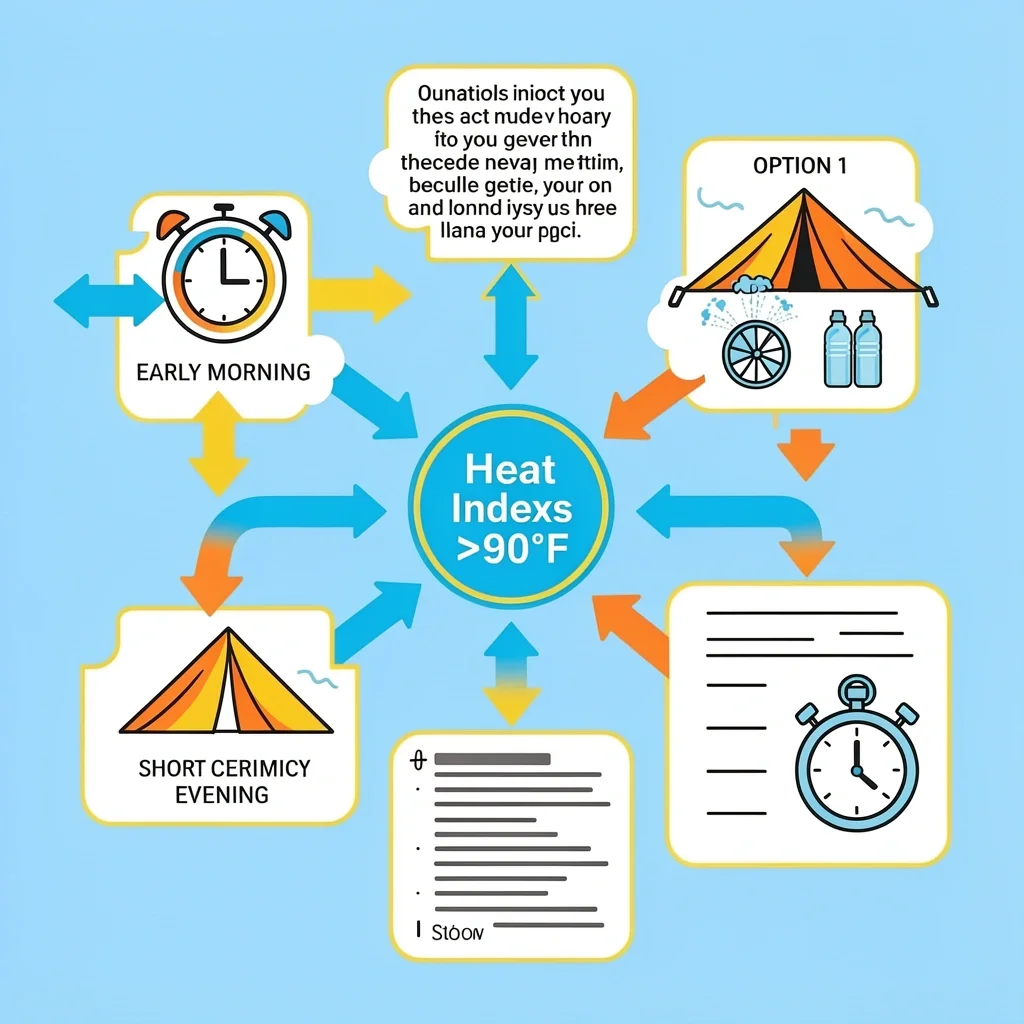
You have three options when the forecast shows a heat index above 90°F during your ceremony window. Do not pick the backyard plan that you will change at the last minute. Pick one option and commit to it at least two days before the wedding.
For those determined to celebrate in their own yard, exploring ideas for a backyard wedding that actually work in your yard can provide creative alternatives that prioritize comfort and style.
Option One: Change the Time
Move the ceremony earlier in the morning, before 10 a.m., or later in the evening, after 6 p.m. This is the simplest fix if your venue allows it. The heat index can drop 10°F to 15°F between 4 p.m. and 6 p.m. in summer. Check the forecast for your new time to make sure it solves the problem.
Option Two: Create Active Cooling
If you cannot change the time, you must add cooling infrastructure. This costs money but protects your guests. You need:
- A shade structure over every seat, not just the couple. A tent with a solid roof works best. A mesh canopy provides some shade but less cooling.
- Commercial misting fans placed around the perimeter of the seating area. These lower the air temperature by 5°F to 10°F directly around them.
- Ice water at every seat, not just at a station. Place bottles of water under each chair before guests arrive.
- Cooling towels at the entry. Wet them with cold water and hand them to guests as they arrive. Guests can drape them over their necks during the ceremony.
Option Three: Shorten the Ceremony
Cut the ceremony script to under 10 minutes. This means no readings, no songs, no personal vows longer than one sentence each. The officiant says the necessary legal words, you exchange rings, and you are done. You can do longer readings and vows during the reception where there is air conditioning or shade. This option works only if you are willing to sacrifice ceremony length for safety.
How to Build a Real Backup Plan
A good backup plan is not just a phrase like we will move inside if it rains. It is a specific, costed, and communicated alternative that you can activate 24 hours before the wedding.
Start by asking your venue what indoor or shaded spaces are available. Reserve one of these spaces as a backup option. If the space costs extra, pay for it. The cost of an unused backup space is cheaper than the medical bills for multiple guests with heat illness.
Set a clear trigger for activating the backup. Pick a number: if the heat index is above 92°F at 3 p.m. for a 5 p.m. ceremony, you move inside. Do not wait until the ceremony starts. Make the call early so you can tell guests where to go.
Communicate the backup plan to guests through your wedding website. Use language like: Our ceremony is planned for the outdoor garden. If the heat index exceeds a safe level, we will move to the indoor ballroom across the courtyard. Check our website the morning of the wedding for a final update. This gives guests confidence that you have thought about their safety.
If moving indoors is not possible because no indoor space exists, you need a tent with solid walls and air conditioning. Rent a tent with sidewalls and portable air conditioning units. This costs more than an open tent, but it is the only way to create a cool environment outdoors when the heat is extreme.
Frequently Asked Questions
Can I have an outdoor wedding in 100°F?
Only if the ceremony is under 10 minutes, you have shade and misting fans over every seat, and you warn guests to prepare with light clothing and hydration. Even then, heatstroke risk remains. The safer choice is to move indoors or change the time.
What is the best time of day to avoid extreme heat?
10 a.m. to 4 p.m. are peak heating hours. Aim for late afternoon after 5 p.m. or early morning before 10 a.m. The heat index is usually 10°F to 15°F lower outside these windows.
Should I provide cooling items like wet towels or ice pops?
Yes. Wet cooling towels placed on the neck or back of the neck lower body temperature effectively. Ice pops provide hydration and a cooling sensation. Offer these at the ceremony entry point. They are especially helpful for guests in the moderate and high vulnerability tiers.
How do I tell guests it might be hot without sounding negative?
Use a dedicated weather and attire page on your wedding website. Say something like: Our ceremony is outdoors in the garden. We recommend Southern summer style light fabrics, wide brimmed hats, and comfortable shoes. Water and cooling towels will be provided. This frames the heat as part of the experience instead of a problem.
What if some guests have medical conditions like heat intolerance?
Suggest they bring their own cooling vest or portable fan. Create a cool down zone near the ceremony area with a shaded tent and a fan that blows on a cool surface. If a restroom building with air conditioning is nearby, point it out to them before the ceremony starts so they know where to go if they feel overheated.
Summer weddings are especially beautiful since guests can enjoy a meal before sunset. Just like my friend’s wedding at Victory North Savannah ).
Exactly right, summer weddings allow for a beautiful dinner view.