

When my wife and I first sat down to build a budget together, it lasted exactly seventeen minutes before we were arguing about why she needed another pair of running shoes and I needed a third coffee shop visit that week. We weren’t bad people. We just had different ideas about what money was for. That fight taught me something: budgeting as a married couple has almost nothing to do with spreadsheets and almost everything to do with understanding each other’s financial wiring.
If you’re here because you’re tired of the silent tension or the loud blowups over money, I’ve been there. The tips that follow come straight from real trial and error — not from a textbook. They work because they address the real reason budgets fail: mismatched money personalities, not math.
Why Most Couple Budgets Fail Within Three Months

I’ve watched dozens of couples — friends, family, clients — start a budget with excitement only to abandon it before the season changes. The pattern is always the same: they pick a method (usually the 50/30/20 rule), plug in their numbers, feel great for two weeks, then hit a snag and never recover.
The real reason isn’t that they chose the wrong percentages or the wrong app. It’s that they skipped the foundational work. A budget is a financial plan, but a marriage is an emotional partnership. If you don’t address the emotional side first, no plan will stick.
Here are three signs that your current approach is doomed:
- Resentment. One partner feels the budget is controlling or unfair.
- Secrecy. Small purchases get hidden because one person fears judgment.
- Avoidance. You keep postponing the monthly money talk because it always ends badly.
The good news is that 60 percent of couples clash over money at some point — that’s normal. The difference between those who figure it out and those who don’t is the willingness to pause the math and understand each other first.
The Money Script Audit — Understanding Your Financial Wiring
Before you touch a single dollar sign, you need to understand the unspoken forces shaping your financial decisions. Every person carries a “money script” — beliefs about money learned from childhood. Your partner’s script is probably different from yours, and that’s where the friction comes from.
Exploring Your Financial Origin Stories
Set aside thirty minutes with your spouse. Each of you answers these questions separately, then shares your answers:
- What did your parents teach you about money — both explicitly and by example?
- What is your most vivid childhood money memory, positive or negative?
- What does having “enough” money mean to you emotionally?
My wife grew up in a house where money was scarce. She learned that if you didn’t spend it now, it might disappear. I grew up in a house where money was never discussed. I learned to avoid thinking about it entirely. Realizing that helped us stop blaming each other and start solving together.
Identifying Your Money Personality
Most people fall into one of five categories:
- The Saver. Loves watching the account grow. Feels anxious when spending.
- The Spender. Enjoys using money for experiences and things. Feels restricted by saving.
- The Avoider. Prefers not to think about money. Delegates all financial tasks.
- The Planner. Needs spreadsheets, categories, and goals. Feels lost without structure.
- The Risk-Taker. Comfortable with investing and uncertainty. Bored by rigid budgets.
The Saver-Spender combination is the most common source of conflict in marriages. If that’s you, don’t panic — it’s workable. The key is to design a system that gives both personalities something they can live with.
Exercise: Each partner writes down their top three financial fears and top three financial dreams. Exchange papers. You’ll likely discover that your biggest fears are different — and that your dreams actually overlap more than you expected.
Aligning on Shared Financial Values
Once you understand each other’s scripts and personalities, define what money is for in your marriage. Together, rank these five values in order of importance: Freedom, Security, Generosity, Legacy, Experience. If you rank Security #1 and your partner ranks Experience #1, you now know where your future negotiations will center. That awareness alone prevents hundreds of arguments.
The Four Budgeting Structures That Actually Work for Couples

Based on everything you just learned about your combined money personalities, pick a structure that honors both of you. There is no one-size-fits-all. These four options cover the most common dynamics.
For a broader set of strategies, The Expense Sharing Playbook covers twelve proven systems for various relationships.
Structure 1: The Completely Combined Approach
Best for: Couples who view finances as fully shared — typically traditional married dynamics with high trust and similar spending habits.
Pros: Maximum simplicity, complete transparency, aligned incentives.
Cons: Can feel controlling to partners who value autonomy. If one person is a Saver and the other a Spender, this structure often causes resentment.
Structure 2: The Three-Bucket System (Ours, Yours, Mine)
Best for: Couples who want unity plus independence — the most common recommendation I give.
Mechanics: Open a joint account for shared expenses (mortgage, utilities, groceries, savings). Each partner keeps a separate account for personal spending. The typical split is 70–80 percent combined, 20–30 percent individual.
Why it works: The joint account covers life together. The separate accounts give each person the freedom to buy that pair of shoes or coffee shop visit without having to justify it. This single change eliminated 80 percent of our money arguments.
Structure 3: The Proportional Split Model
Best for: Significant income disparities or second marriages with blended family obligations.
Mechanics: Each partner contributes to joint expenses in proportion to their income. If Partner A earns 60 percent of household income, they cover 60 percent of joint costs. This feels fairer than a 50/50 split when incomes are very different.
Structure 4: The Hybrid Variable System (For Irregular Income)
Best for: Freelancers, commission earners, gig workers, seasonal employees.
Mechanics: Budget based on your minimum guaranteed income — the lowest amount you can count on each month. All extra income goes into a “surplus bucket” that you allocate together: 50 percent to goals (debt, savings), 30 percent to wants, 20 percent to building a buffer.
The buffer month rule: Before you start variable budgeting, set aside one month of core expenses in a separate account. That way, a slow month doesn’t mean a crisis.
Decision framework: Ask these three questions to choose the right structure for your marriage:
- How much financial autonomy does each partner need to feel respected?
- How different are your spending habits? (Very different? Lean toward more separate accounts.)
- Is your income stable or variable? (Variable? Use the hybrid system.)
The Weekly Money Meeting — Your Marriage’s Financial Checkup

The structure is important, but the process of managing it weekly is what determines success. Monthly meetings are too infrequent — by the time you check, the damage from a spending mistake is already done.
Format and Frequency
- Weekly: Same day, same time every week. Ours is Sunday evening after dinner.
- Duration: 30 minutes maximum. Longer meetings breed resentment.
- Setting: Neutral territory — the living room couch, a coffee shop, anywhere without distractions. One device only, for checking the budget.
The Meeting Agenda (Replicable Template)
- The Victory Lap (5 minutes): Each partner shares one financial win from the past week — avoiding an impulse purchase, finding a deal, sticking to the plan. This sets a positive tone.
- The Scoreboard (10 minutes): Review spending against budget categories. No judgment zone. This is data, not character assessment. If one category is over, ask “What happened?” not “Why did you do that?”
- The Forecast (5 minutes): Upcoming irregular expenses — birthdays, car repairs, annual subscriptions. Planned purchases. Calendar events that might affect spending.
- The Adjustment (5 minutes): Where does the budget need flexibility this week? Is one category over- or under-funded? Shift money as needed — it’s your plan, you can change it.
- The Check-In (5 minutes): “How are we feeling about money right now?” Use a 1–10 emotional scale. If either partner scores below a 6, the next meeting should focus on that feeling first.
Conflict De-escalation Protocol
Even with the best intentions, tension can rise. Here’s the break-glass-in-case-of-emergency plan:
- The Pause Rule: If either partner’s emotional temperature exceeds 7 out of 10, table the discussion for 24 hours. No resolution happens when emotions are hot.
- The Curiosity Frame: Replace “Why did you spend that?” with “Help me understand what was going on when you made that decision.” This shifts from accusation to understanding.
- The Compromise Formula: Identify the underlying need behind the disagreement. Brainstorm three options. Pick one to try for two weeks. Re-evaluate.
The Hidden Budget Leaks Most Couples Miss in Today’s World
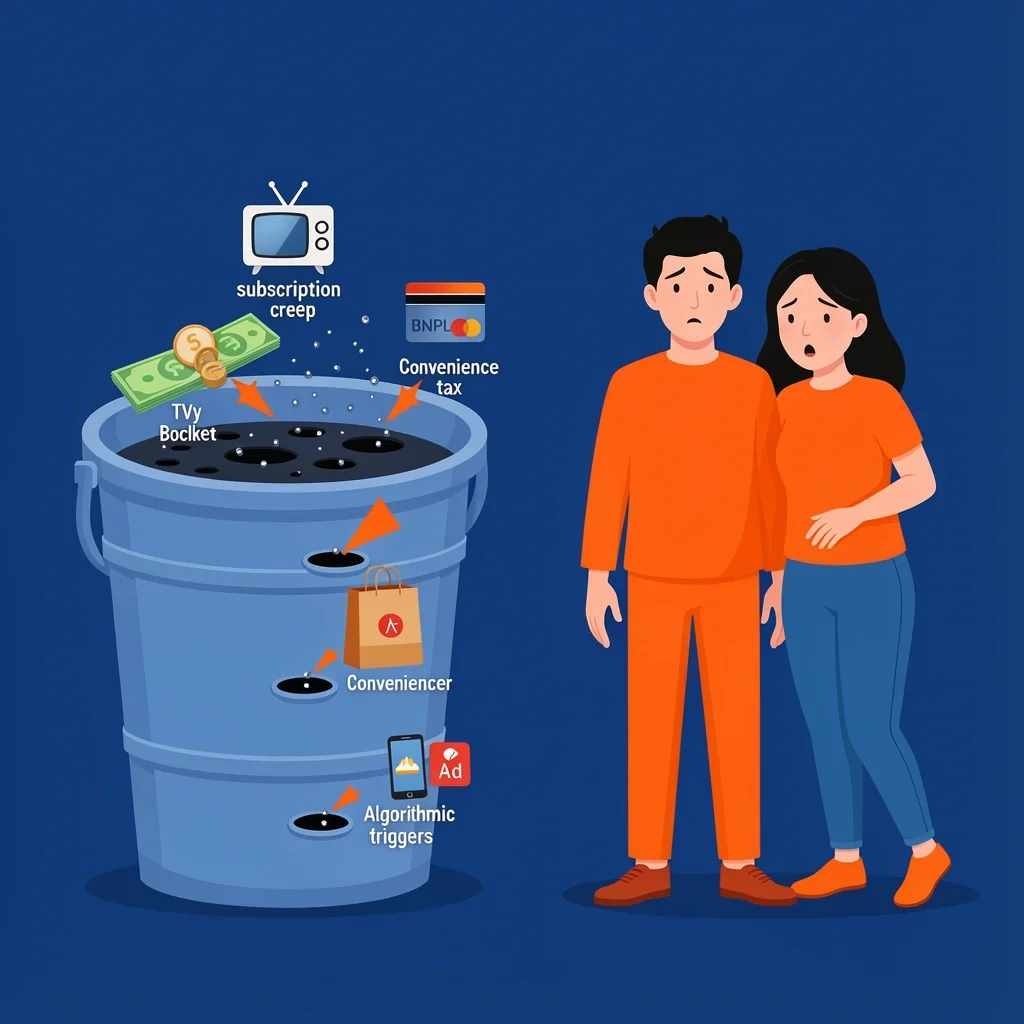
With a solid structure and a weekly meeting rhythm, you have the skeleton of a working budget. Now let’s address the silent killers that eat away at your progress.
Subscription Creep
I once discovered we were paying for three streaming services we hadn’t touched in four months. The average couple spends over $300 a month on forgotten subscriptions. Audit protocol: Review bank statements every quarter for recurring charges. Cancel anything not used in the last 30 days.
Buy Now Pay Later Debt
BNPL transactions like Klarna, Afterpay, and Affirm often don’t register as “debt” in traditional budgeting. They’re small payments spread out, easy to ignore. But multiple small payments stack up into a significant monthly obligation. Tracking method: Maintain a separate BNPL tracker in your budgeting tool. Treat each payment as a fixed expense, just like a utility bill.
The Convenience Tax
Delivery fees, service charges, tip creep on digital transactions — these small amounts add up fast. My wife and I did a two-week “convenience audit” and discovered we were spending over $200 a month on fees and tips for DoorDash, Uber, and online orders. Habit audit: Track all convenience spending for two weeks. Ask yourself: Which of these is truly saving me time I value, and which is just laziness I can’t afford?
Algorithmic Spending Triggers
Social media ads are designed to find your exact desires. The solution is simple: the 24-hour rule. No purchase over $50 made on the same day you discover it. Write it down, wait a day, then decide. Also do an unsubscribe audit — unfollow retail accounts, brand newsletters, and influencer channels that trigger FOMO spending.
Automation Architecture — Building Your Budget to Run Itself

Plugging leaks is essential, but real financial momentum comes from automating your systems. When money moves automatically, you can’t forget or fight about it.
The Automation Hierarchy
- Essential fixed costs first: Rent/mortgage, utilities, insurance — automate these on payday.
- Debt minimums: Automate every minimum payment. Never rely on your memory.
- Goal funding: Automate savings, investments, and sinking funds on the same day.
- Variable spending is what remains: The money left after automation is your discretionary pool — no guilt, no tracking needed.
The Sinking Fund Strategy for Couples
Sinking funds are separate savings buckets for predictable irregular expenses — holidays, car repairs, annual insurance, vet bills. Most couples fight because one partner sees a “surplus” in checking and spends it, while the other was mentally reserving that money for future expenses. Setting up sinking funds with automated micro-transfers each payday eliminates that conflict entirely. Start with 5–10 categories and automate small amounts per pay period.
Debt Acceleration Together
List all debts. Pay minimums on everything. Throw all extra cash at one target. Which target? That’s where couples often disagree. Here’s a compromise: snowball (smallest balance first) gives quick wins and motivation. Avalanche (highest interest first) saves the most money. Agree to use snowball for the first three debts for momentum, then switch to avalanche. Most important: define what your debt-free celebration looks like together — a trip, a fancy dinner, a new piece of furniture. That shared goal keeps you going.
Adapting Your Budget Through Life’s Transitions
No budget survives contact with reality perfectly. The goal isn’t perfection — it’s rapid recovery when you veer off course. Life will throw curveballs, and your budget needs to flex.
Income Change (Job Loss, Promotion, Career Shift)
Immediate protocol: Reduce variable spending to 80 percent of normal. Pause non-essential sinking funds. Communication imperative: Do not hide financial stress from your spouse. Transparency preserves trust. My wife and I have a rule: any income change, good or bad, is discussed within 24 hours.
New Baby
Diapers run about $80 a month. Formula or breastfeeding supplies add more. Lost income from leave is a blow. But there’s a hidden savings: you eat out less, you have fewer social obligations. Redirect that money to baby expenses. Also, pause date nights — replace them with at-home quality time.
Blending Families (Remarriage with Children)
The complexity multiplies. Child support, alimony, different spending histories, legacy obligations. The “yours, mine, ours” three-bucket structure becomes critical here. I strongly recommend keeping separate debt ownership until trust is fully established — typically a year or two.
Major Purchase Planning (Home, Vehicle, Renovation)
The six-month collaboration rule: Both partners agree on purchase parameters (price range, features, timeline) before shopping begins. The veto power agreement: Each partner has unilateral veto on purchases exceeding an agreed threshold — say $1,000. That means no one feels steamrolled into a decision they’re not comfortable with.
When You’ve Tried Everything and It’s Still Not Working

Sometimes the standard advice doesn’t stick. If you’re in that place, don’t give up — troubleshoot your specific failure mode.
One Partner Is Disengaged Entirely
Root cause: Often not laziness, but feeling financially inadequate or controlled. The partner who handles everything may unintentionally disempower the other. Solution: Switch to “parallel budgets” — each partner manages their own spending within agreed boundaries. Meet monthly to compare, not to judge. After a few months, the disengaged partner often feels more confident and willing to join the shared system.
Overspending Despite Good Intentions
Root cause: Emotional spending, boredom, or unmet needs being met through purchases. Solution: Try the “allowance reversal” — give each partner an equal amount of personal spending money, no questions asked. When people feel free to spend a small, predetermined amount without judgment, the urge to rebel or secretly overspend drops dramatically.
Chronic Under-Earning Conversations
Root cause: Different views on career ambition, risk tolerance, or life balance. Solution: Separate the money conversation from the career conversation. Discuss income as a planning variable, not a character assessment. Ask: “Given where we are, what can we realistically do with the income we have right now?” rather than “Why aren’t you earning more?”
Past Financial Infidelity (Hidden Accounts, Secret Debt)
Root cause: Broken trust requires different repair than technical fixes. Solution: Implement a temporary financial transparency period — full access to all accounts, joint accounts only — with a predetermined reconciliation timeline (e.g., six months). After that, you can gradually reintroduce individual accounts if desired. Forgiveness takes time, but the transparency rebuilds the foundation.
When to Seek Professional Help
If conversations about money consistently devolve into personal attacks, if secret spending continues after disclosure agreements, or if one partner feels financially controlled or abused, it’s time to bring in a third party. Look for a financial therapist or a coach who specializes in couples — not just a CPA. A good professional can help you untangle the emotions from the numbers.
Frequently Asked Questions
Should we have separate or joint bank accounts?
Research suggests fully joint accounts correlate with stronger relationship satisfaction, but the right answer depends on your money personalities. For most couples, the hybrid approach works best: a joint account for shared expenses and separate accounts for personal spending. This combines unity with autonomy.
How do we handle budget disagreements without fighting?
Use the “next week rule.” If you disagree on a budget item, allocate the money to a holding category for one week. Revisit the issue with the intention of finding a compromise, not winning an argument. The time gap usually cools emotions and reveals creative solutions.
What percentage of our income should go to savings as a couple?
Start with 20 percent as a baseline target. If that’s impossible, begin with 5 percent and increase by 1 percent every quarter. Consistency matters more than the percentage — a small, steady habit beats a perfect plan you abandon after two months.
How do we budget when we have irregular income?
Budget from your “base salary” — the minimum you can reliably earn each month. Treat all extra income as a bonus to be allocated: 50 percent to goals (debt, savings), 30 percent to wants, 20 percent to building a buffer account. The buffer account smooths out the lean months.
Should couples pay off debt or save first?
Do both simultaneously. Maintain a starter emergency fund ($1,000–$2,500) while aggressively attacking debt. Once the debt is gone, build the emergency fund to 3–6 months of expenses. This protects you from life’s surprises while still making progress on debt.
How do we involve children in family budgeting?
Use age-appropriate transparency. Young children can see the “fun money” envelope running low. Teens can observe your weekly money meeting (no pressure to participate). Never use money conversations to shame or frighten children — instead, frame it as teamwork and planning.
What’s the fastest way to get on the same page about money?
Read one personal finance book together — not separately. Discuss it chapter by chapter. I recommend starting with The Simple Path to Wealth for the technical side and The Meaning of Marriage for the relational side. When you learn together, you build a shared language and shared goals.